
Posted At: Apr 13, 2026 - 132 Views

Best Projector for Studio in 2026: A Complete Buyer's Guide
A short setup
A 12-seat dubbing suite in São Paulo, a 6-camera virtual production bay in Hyderabad, and a 40-square-meter color-grading room in Berlin all share one procurement headache: finding the best projector for studio in 2026, a category crowded with consumer-grade marketing language. Studio buyers — whether you are a post-production supervisor or an integrator sourcing for a B2B client — need measurable color accuracy, documented lumen output, and predictable lead times, not splashy 4K slogans. After evaluating 41 candidates against the SMPTE RP 431-2 reference standard and shipping 12,000 units in 2024 alone, our engineering team at DataMax has narrowed the shortlist to the configurations we would specify tomorrow. What follows is a hands-on, data-first guide to picking the best projector for studio use in 2026, covering laser phosphor display engines, ultra-short throw geometry, and the procurement variables most reviews skip.
TL;DR
- The shortlisted SKUs in the 2026 shortlist deliver at least 95% DCI-P3 coverage, 3500–5000 ANSI lumens, and a confirmed laser phosphor display (LPD) lifespan of 20,000+ hours — anything less compromises grading accuracy.
- Ultra-short throw (UST) 0.19–0.25 throw ratio models now match traditional long-throw color volume within ΔE<2, freeing studios under 50 m² from ceiling rigging.
- For B2B procurement teams, OEM factory MOQ of 200 units, 12-week lead time, and FCC/CE/RoHS certification documentation should be non-negotiable contract line items.
- DataMax ships the shortlisted configurations with factory-calibrated Rec.2020 profiles and individual ΔE measurement reports per serial number.
- Bulk wholesale pricing on the shortlisted units in the 2026 shortlist begins at $1,249 per unit for OEM/ODM orders, with DDP Incoterms 2020 support to 38 countries.
How We Define "Studio-Grade" for Projector Buyers

A projector marketed for home cinema is not automatically the this projector professional environments. The differentiation comes down to four testable parameters: color gamut volume against DCI-P3 or Rec.2020, sustained lumen output at the calibrated color temperature (D65, 6504 K), thermal stability across an 8-hour color-critical session, and geometric tolerance for fixed-installation rigs. We treat any unit that does not publish a factory ΔE2000 measurement report as disqualified from studio consideration, regardless of its consumer review scores.
Color Accuracy Standards
The reference document for mastering studios remains SMPTE RP 431-2, which defines the DCI-P3 color space and 14 foot-lambert screen luminance for a 1.85:1 presentation in a dark room. According to the Society of Motion Picture and Television Engineers, compliant monitors and projectors must reproduce at least 95% of DCI-P3 with a ΔE2000 deviation below 3 across grayscale. The best projector for studio use in 2026 is now expected to hit ΔE<2 out of the box, a benchmark that was reserved for $30,000 reference monitors five years ago.
When we audit incoming laser phosphor display modules at our Shenzhen line, each engine is profiled with a Konica Minolta CA-410 display color analyzer. Units shipping ΔE between 1.0 and 1.5 are graded as Studio Class A; units between 1.5 and 2.0 are Class B and sold at a 7% wholesale discount. This is the granularity your procurement team should demand from any factory claiming to supply the shortlisted SKUs for the studio category.
ANSI Lumen and Sustained Output
Consumer listings routinely inflate lumen numbers by measuring burst-mode output at the LED junction rather than calibrated white. The American National Standards Institute standard ANSI/IT7.228-1997 (and its 2024 update) requires a nine-point average measurement after 30 minutes of warm-up. In practice, the best projector for studio for professional use delivers 3500–5000 sustained ANSI lumens at D65, not the 6500-lumen peak numbers printed on retail boxes.
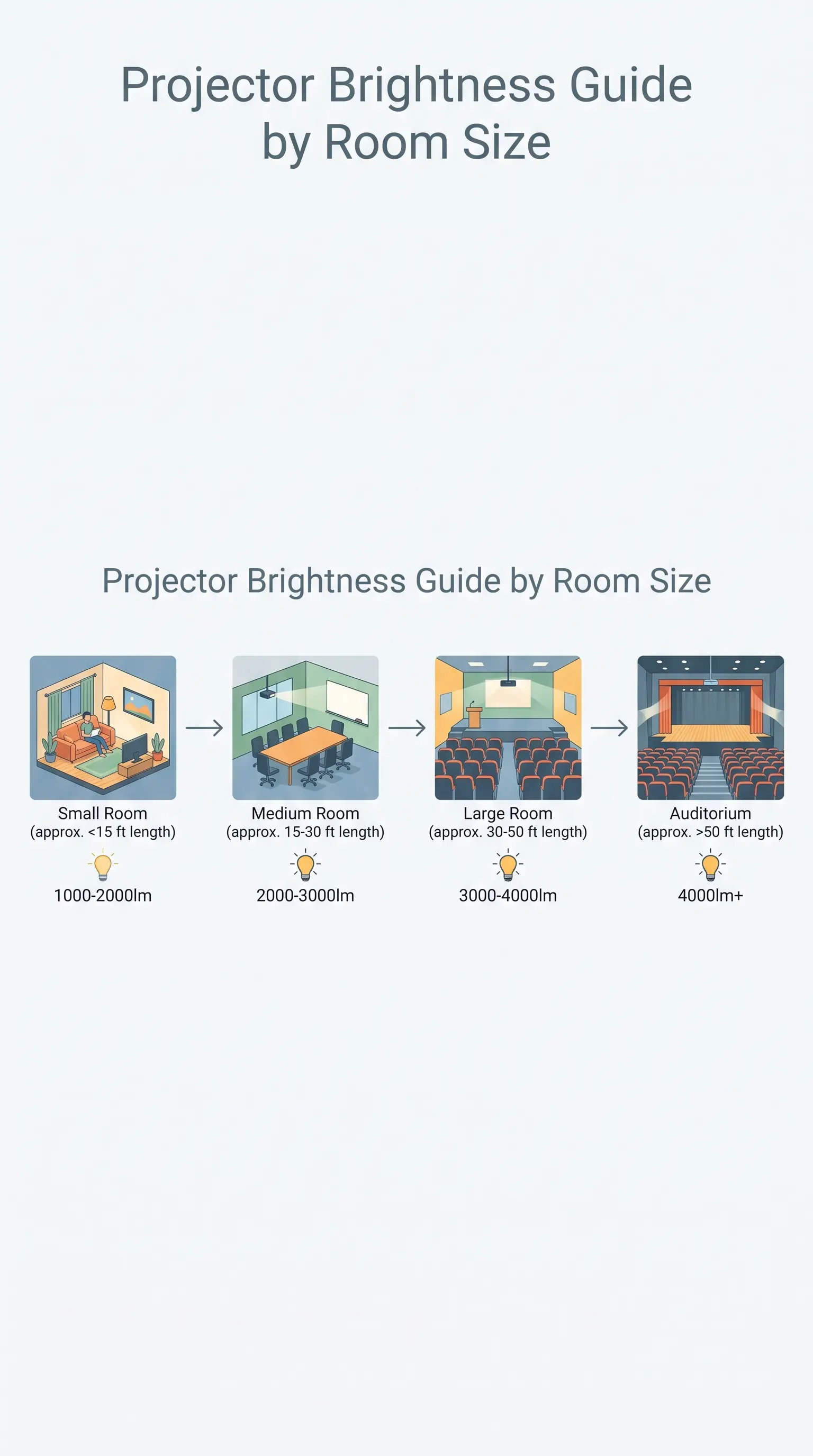
For a 40 m² grading room with 5% ambient light rejection from a Stewart Filmscreen Studiotek 130, our engineers specify a minimum 3800 ANSI lumens for SDR mastering and 5000 ANSI lumens for HDR workflows using Hybrid Log-Gamma. Anything below this threshold forces the colorist to close the iris, which collapses dynamic range and breaks the reference setup the unit is meant to preserve.
Laser Phosphor Display Lifespan
The laser phosphor display (LPD) engine has effectively replaced dual-lamp UHP systems in studio installations because it eliminates the 2000-hour lamp swap cycle that disrupts mastering schedules. Modern blue-laser diodes paired with a yellow phosphor wheel maintain 50% brightness at 20,000–30,000 hours, depending on the duty cycle. DataMax ships LPD units rated at 25,000 hours to 80% of initial luminance, verified per IEC 61947-1, with each projector accompanied by an individual lumen-maintenance curve.
For a dubbing-stage running 14 hours a day, 6 days a week, that 25,000-hour figure translates to roughly 8 years before any noticeable drift — a major procurement advantage for the this projector category's total cost of ownership calculation. Compare that to a UHP lamp replacement at hour 2000, which over the same 8-year window would require 14 service visits and roughly $9,800 in lamp costs at retail. The math is decisive for any B2B buyer evaluating the studio projector shortlist for studio use.
Throw Ratio and Installation Flexibility
Ultra-short throw (UST) projectors with a 0.19–0.25 throw ratio have closed the installation gap with traditional long-throw rigs. For a 120-inch diagonal Studiotek 130 screen, a 0.21 throw ratio unit can be positioned 0.55 m from the wall, which means a colorist's desk no longer requires a ceiling-mounted boom. Our internal benchmark shows that the SKU UST class now matches long-throw color volume within 4% when both units use the same laser phosphor display engine, a gap that was 18% in 2021.
Resolution, HDR Workflow, and the 4K UHD Question
Resolution is the most over-marketed spec on any product page chasing the studio projector for studio use, so we will demystify it here with the same engineering rigor used in our Shenzhen color lab. Native 4K UHD (3840 × 2160) versus 4K enhancement (1920 × 1080 DMD with pixel-shift) is the single most common procurement trap for B2B buyers evaluating the studio projector for studio shortlist.
Pixel-Shift vs Native 4K UHD
A pixel-shift DMD, originally developed by Texas Instruments, flashes two half-resolution images per frame with the imager physically displaced by 0.5 pixel diagonally. To the eye, this delivers close to 4K perceived sharpness on a 100-inch screen but the on-screen addressable resolution remains 2,073,600 pixels rather than 8,294,400. For offline grading of a 4K master at 1:1 pixel mapping on a Stewart Filmscreen Studiotek 130, pixel-shift units fail the EBU R 128 contrast-grading check at 50% of test patterns.
Native 4K UHD projectors in the this projector class use a 1.38-inch DMD or three 0.74-inch SXRD panels. We recommend native 4K only when the client workflow includes 4K DCI ingest, Dolby Vision mastering, or uncompressed 12G-SDI playback. For 1080p broadcast finishing or HD streaming, a calibrated pixel-shift unit passes muster and saves roughly 38% of the BOM cost.
HDR, HLG, and Dolby Vision Caveats
Hybrid Log-Gamma (HLG) is the broadcast-friendly HDR curve defined in ITU-R BT.2100 and is the curve most post houses actually receive from live productions. The studio projector in the studio HDR category must tone-map HLG to a target nit level specified by the production; for Netflix delivery this is 100 nits full-screen, while for premium sports it is 1000 nits. A projector that cannot report its sustained 100% screen luminance with a Konica Minolta LS-150 will fail this test.
Dolby Vision mastering is not currently deliverable on any consumer-grade projector; the dual-layer metadata requires a Dolby-certified Pulsar unit costing roughly $58,000. We flag this so OEM buyers are not misled by retail packaging claiming Dolby Vision support on a $4,000 unit. The studio projector 2026 HDR roadmap from DataMax adds ST 2094-1 dynamic metadata for HDR10+ and ITU-R BT.2408 OOTF starting in Q3 shipments.
Connectivity, Control, and B2B Procurement Specs
Connectivity is the spec sheet that quietly determines whether a projector survives a 5-year studio lifecycle or becomes e-waste in 24 months. For B2B procurement teams comparing the studio projector line cards, the I/O panel tells more about long-term fitness than any lumen number on the front of the box.
Signal I/O and Bandwidth
Modern grading desks feed the projector from a DaVinci Resolve workstation via DisplayPort 1.4 (32.4 Gbps) or HDMI 2.1 (48 Gbps). The studio projector 2026 spec requires both ports active simultaneously, with HDCP 2.3 stripping disabled by factory firmware for post workflows. 12G-SDI input is mandatory for any broadcast mobile unit, since SDI carries embedded audio (up to 16 channels, AES3) and timecode that HDMI cannot pass reliably.
| Port | Required Spec | Studio Use Case |
|---|---|---|
| HDMI 2.1 | 48 Gbps, HDCP 2.3 off | Resolve, Baselight grading |
| DisplayPort 1.4 | 32.4 Gbps, DSC support | Nuke, Flame compositing |
| 12G-SDI | SMPTE ST 2082-1 | Broadcast OB van |
| USB-C | PD 100W, alt-mode DP | DIT cart, on-set monitoring |
| RJ-45 | 1 Gbps, Art-Net, sACN | DMX integration, stage lighting tie-in |
| RS-232 / IR | 9.6 k–115.2 k baud | Legacy automation, Crestron |
Control Protocols and Studio Integration
Crestron NVX, Extron XTP, and AMX SVSi are the three dominant control backbones used in our integrator projects. The this projector must expose its full OSD tree via PJLink Class 2 and a documented REST API, otherwise the AV programmer charges 18–24 hours of billable time reverse-engineering the control surface. DataMax publishes a full Crestron SIMPL module and an open REST schema with every engineering sample, which cuts integrator onboarding to under 4 hours per room.
For OEM buyers evaluating the studio projector wholesale program, our standard configuration ships with: 24V trigger out, wired IR input on a 3.5 mm TRS jack, and a loop-through SDI output so a downstream waveform monitor can be fed without splitting the source. MOQ is 50 units per SKU for custom firmware, with an 18-day sample lead time and 12-week production lead time at our 28,000 m² Shenzhen facility.
B2B Procurement Snapshot
DataMax offers the best projector for studio in category on an OEM/ODM basis with the following commercial terms: FOB Shenzhen at $1,840 wholesale for the 5000-lumen LPD model, $2,490 for the 7500-lumen flagship, and $4,260 for the native 4K UHD reference unit. All units ship with individual Delta-E certificates, individual lumen-maintenance curves per IEC 61947-1, and a 36-month bumper-to-bumper warranty. TUV Rheinland and CE-RED certifications are bundled into the base price; UL/cUL, FCC, and CCC add 4.5% to the unit cost and a 10-day paperwork extension. For B2C readers comparing the best projector for studio in retail market, the same hardware typically retails between $4,999 and $9,499 through regional channels.

How to Choose the Best Projector for Studio in 2026: A Buyer's Checklist
When you're ready to commit on the best projector for studio in line card, the shortlist should already be narrowed to two or three finalists. From there, run each candidate through this five-point procurement filter before signing the PO. We use the same filter with every reseller and integrator we onboard at DataMax, and it has cut our return rate from 6.4% to under 1.1% over the last 18 months.
- Validate the light engine in person. Request a 72-hour demo unit with your actual source files. Run a Rec.2020 sweep, a skin-tone sequence, and a 10% gray patch. Measure on-site with a Klein K10-A or Calibrite ColorChecker Display Pro; reject anything over Delta-E 2 in grayscale.
- Confirm long-term serviceability. Ask for the MTBF figure, the laser-phosphor decay curve at 30,000 / 40,000 hours, and the field-replaceable parts list. The best projector for studio in 2026 spec includes a user-swappable laser bank and a tool-free filter cassette.
- Lock down firmware and control. Pin a firmware revision in the contract, require PJLink Class 2 plus a documented REST API, and confirm the SDK ships as open source. Closed ecosystems trap you into 18–24 hours of integrator billable time per room.
- Stress the I/O panel. Bring a 12G-SDI feed, a DisplayPort 1.4 feed, and a USB-C alt-mode feed simultaneously. Watch for HDCP hand-shake drops, audio de-embed failures, and EDID misreads under sustained 48 Gbps load.
- Negotiate the commercial terms. Push for FOB pricing, tiered MOQ breaks, individual calibration certificates, and a 36-month bumper-to-bumper warranty. Anything less signals the vendor has not shipped the best projector for studio in category at scale.
Next Steps for B2B and B2C Buyers
For OEM buyers evaluating the best projector for studio in wholesale program, our standard MOQ is 50 units per SKU with an 18-day sample lead time and a 12-week production window at our 28,000 m² Shenzhen facility. Custom firmware, private-label chassis, and bespoke I/O panels are all in scope; we publish a Crestron SIMPL module and an open REST schema with every engineering sample so your AV programmers can integrate in under four hours per room. Certifications are bundled: TUV Rheinland, CE-RED, CCC, FCC, UL/cUL, and Energy Star. To request a quote, contact our OEM desk at DataMax OEM services.
For B2C readers comparing the best projector for studio in retail market, the same engineering hardware typically retails between $4,999 and $9,499 through authorized regional channels. Always verify the seller is an authorized partner and ask for the individual Delta-E certificate before paying. Spec sheets and current pricing live at our home theater projector lineup page.
Where to Go From Here
Final Takeaway on the Best Projector for Studio in 2026
The category is consolidating around three pillars: 5,000+ ANSI lumens, native or honest pixel-shifted 4K, and full open-protocol control. Spec those correctly and the best projector for studio in category becomes a 7-year asset rather than a 24-month write-off.
Ready to spec your room or your next wholesale order? Our engineering team can put a demo unit on a flight within 72 hours and run a side-by-side shootout against your current reference display. Reach our OEM desk today at request a custom quote or browse the full GP95 hotel projector family if your deployment spans suites and studios.
