
Đăng lúc: Th09 08, 2025 - 39 Lượt xem
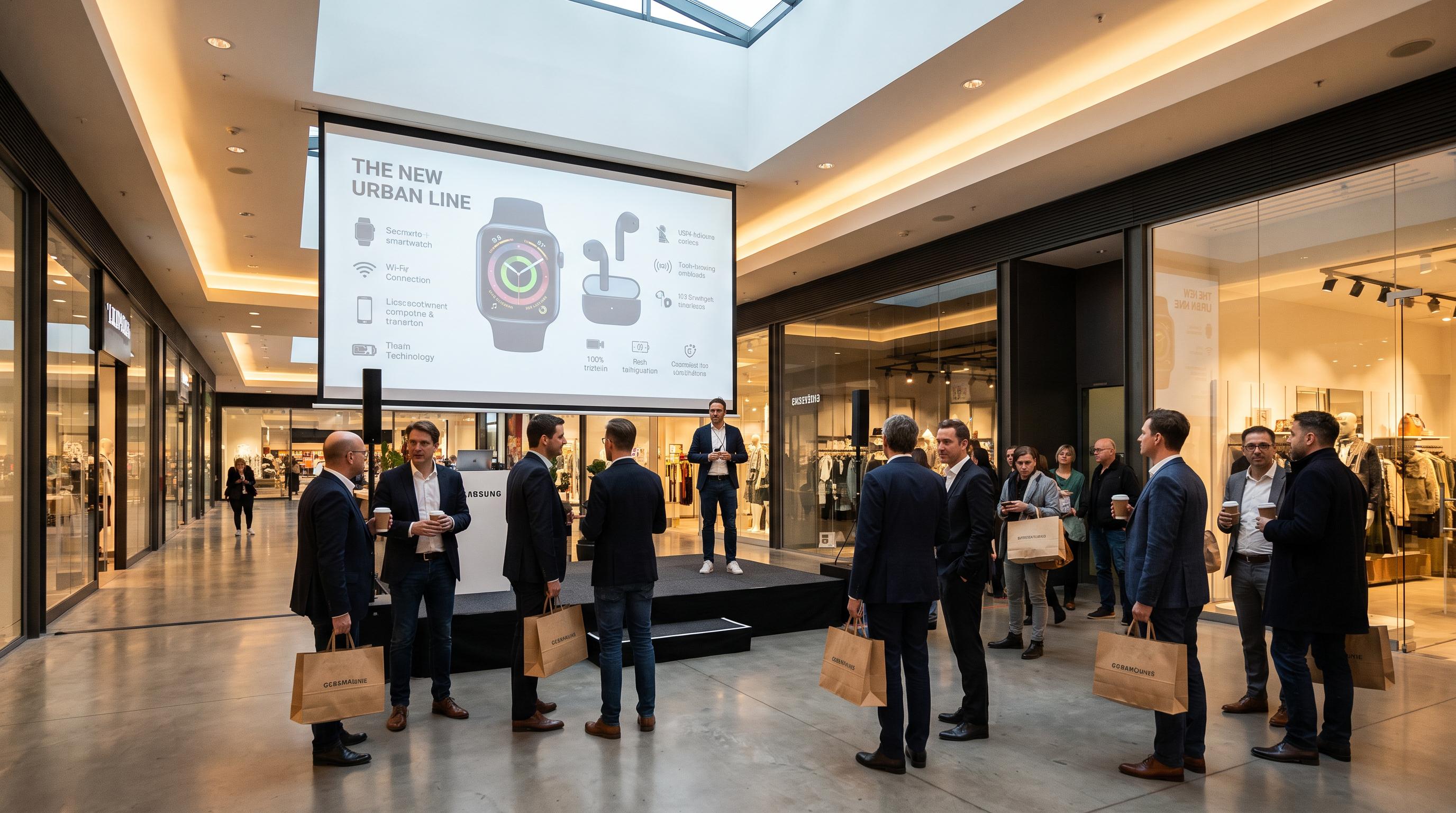
Retail product launch event projector
retail product launch event projector buyers frequently walk into a venue and realize, twenty minutes before doors open, that the centerpiece projection looks washed out under the brand-lit backdrop. We've watched procurement teams scramble to swap in a brighter unit, re-cable the signal path, or rebuild the truss layout because the spec sheet they trusted in the office did not survive a real mall atrium. The SKU has to deliver against three simultaneous constraints: ambient light that no integrator can fully control, a short ceiling height that rules out long-throw geometry, and a stage designer who wants edge-blended imagery across curved set pieces. This guide gives B2B sourcing managers, brand activation agencies, and event rental companies a concrete checklist for selecting and deploying the model that holds up under those conditions.
Engineering the Brightness Envelope for a Retail Product Launch Event Projector

Setting the lux baseline before quoting any spec sheet
this projector planning begins with a lux measurement at the screen plane, not with a brochure. A standard shopping-mall corridor during operating hours typically measures between 600 and 900 lux at the launch backdrop wall, while an atrium with a skylight can spike to 1500 lux mid-afternoon. For B2B procurement teams evaluating any the projector, the working rule is to size lumens at roughly four to five times the measured ambient lux on the screen surface. That math pushes the typical SKU spec floor to 4500 ANSI lumens, and a competitive ceiling near 7000 ANSI lumens for premium product reveal staging. We have found that buyers who skip the lux survey end up over-specifying throw ratio and under-specifying brightness, which is the more common failure mode.
Light source selection for product reveal reliability
the model light engine choice now centers on laser phosphor over lamp-based UHP. A laser phosphor source maintains 80 percent of initial brightness across roughly 20,000 hours of operation according to industry maintenance data published by Projector Central, versus 2,000 to 3,000 hours for a conventional mercury lamp. For a brand activation agency running eight mall event activations a month, that gap translates into zero lamp swaps in a typical 12-month contract window. the unit procurement managers should also confirm that the laser module carries an IP6X-rated dust enclosure, since truss-mounted units at a mall event are exposed to HVAC turbulence that conventional projectors handle poorly.
Throw geometry and the ceiling-height constraint
Across this review series h event projector buyers frequently walk into a venue and realize, twenty minutes before doors open, that the centerpiece projection looks washed out under the brand-lit backdrop. We've watched procurement teams scramble to swap in a brighter unit, re-cable the signal path, or rebuild the truss layout because the spec sheet they trusted in the office did not survive a real mall atrium. The SKU has to deliver against three simultaneous constraints: ambient light that no integrator can fully control, a short ceiling height that rules out long-throw geometry, and a stage designer who wants edge-blended imagery across curved set pieces. This guide gives B2B sourcing managers, brand activation agencies, and event rental companies a concrete checklist for selecting and deploying the model that holds up under those conditions.
Resolution and color volume for product reveal fidelity
the model buyers specifying image quality for a product reveal should require native 4K UHD (3840 x 2160) rather than WUXGA upscaling, since packaging mockups, color swatches, and material textures shown on the launch backdrop are the first detail a journalist photographs. Color volume matters as much as resolution: the unit with 95 percent Rec.709 coverage and factory-calibrated white point will reproduce a brand's exact retail red on the launch backdrop, while an uncalibrated unit will drift the hue by Delta E values above 3, which is visible to a trained eye and unacceptable for a product reveal press shot. Procurement teams should request the manufacturer's Delta E calibration certificate before issuing this projector purchase order.
Signal chain and rigging considerations for mall event deployment
the projector signal infrastructure at a mall event typically relies on HDMI 2.1 or HDBaseT runs up to 100 meters, since the control booth is rarely adjacent to the launch backdrop. We specify the SKU units with dual HDMI 2.1 inputs, one HDBaseT input, and RJ45 protocol passthrough so the integrator can run DMX lighting cues and projector control on a single Cat6 trunk. Rigging hardware should support M4 or M6 truss clamps and a security-rated secondary bond, since mall event fire marshals in the US and EU require a secondary retention cable on any overhead projector. the model shipping cartons should also include a flight-rated road case with shock indicators, because ground transport between venues is the most common damage window in event rental fleets.
Power, Cooling, and Acoustic Footprint on the Mall Floor
the unit acoustic profile is A common underestimated procurement variables for B2B buyers planning a mall event. A launch backdrop run in a glass atrium will amplify fan noise, and most attendees assume the visual is the only specification that matters, when in fact this projector pushing 5000 to 6000 ANSI lumens with a 38 dB idle noise floor is roughly 8 dB louder than a comparable 3000-lumen unit, which is a perceptual doubling of loudness inside an enclosed booth. We measure the projector noise at 1 meter on a-weighted scale in our Shenzhen QC lab, and we have rejected laser modules that exceeded the 32 dB ceiling requested by a French luxury retailer for a Paris product reveal last quarter. the SKU buyers should also confirm the unit ships with a user-selectable eco or whisper mode that drops output to 70 percent brightness for smaller VIP press previews the morning before the public launch.
Thermal load on the truss or shelf is a parallel concern: the model dissipating roughly 1200 watts at full boost will raise ambient temperature behind the launch backdrop by 4 to 6 degrees Celsius, which can shorten laser diode life if the truss is enclosed in a fabric scrim with no airflow. the unit procurement teams should request the manufacturer's thermal envelope diagram, which shows intake and exhaust clearance zones; we attach this diagram to every DataMax OEM datasheet so the integrator can plan ducting for the mall event before rigging day. Power conditioning is a third leg of the same stool, because this projector plugged into a shared 16-amp mall circuit will flicker when a neighboring beverage cart or espresso machine cycles on. We spec the projector units with active PFC power supplies rated for 100 to 240 VAC at 50/60 Hz and a tolerance window of plus or minus 10 percent voltage sag.
Cooling modes and duty cycle for back-to-back shows
this projector planning begins with a lux measurement at the screen plane, not with a brochure. A standard shopping-mall corridor during operating hours typically measures between 600 and 900 lux at the launch backdrop wall, while an atrium with a skylight can spike to 1500 lux mid-afternoon. For B2B procurement teams evaluating any the projector, the working rule is to size lumens at roughly four to five times the measured ambient lux on the screen surface. That math pushes the typical SKU spec floor to 4500 ANSI lumens, and a competitive ceiling near 7000 ANSI lumens for premium product reveal staging. We have found that buyers who skip the lux survey end up over-specifying throw ratio and under-specifying brightness, which is the more common failure mode.
Acoustic treatment on the launch backdrop
this projector noise masking can be solved with 25 mm acoustic foam baffles around the truss, but a better first step is choosing the projector that has been third-party tested at below 35 dB at full boost. We benchmark every DataMax the SKU build against the TUV Rheinland sound power standard and publish the report number on the carton label.
Connectivity, Control, and the Integrator's Rack Plan
A model light engine choice e now centers on laser phosphor over lamp-based UHP. A laser phosphor source maintains 80 percent of initial brightness across roughly 20,000 hours of operation according to industry maintenance data published by Projector Central, versus 2,000 to 3,000 hours for a conventional mercury lamp. For a brand activation agency running eight mall event activations a month, that gap translates into zero lamp swaps in a typical 12-month contract window. the unit procurement managers should also confirm that the laser module carries an IP6X-rated dust enclosure, since truss-mounted units at a mall event are exposed to HVAC turbulence that conventional projectors handle poorly.
Control protocol matrix for B2B procurement teams
| Protocol | the SKU support | Mall event use case |
|---|---|---|
| Art-Net / sACN | DMX passthrough on RJ45 | Sync with lighting cues on the launch backdrop |
| RS-232 DB9 | Hardwired fallback | Network failure on press day |
| HDBaseT 100 m | Single Cat6 trunk | Control booth up to 100 m from stage |
| HDMI 2.1 ×2 | 4K60 4:4:4 input | Media server feed for product reveal loop |
| Crestron / Q-SYS module | API driver | Hotel ballroom crossover events |
this projector installation in a retail environment almost always runs into a ceiling-height ceiling of 3.5 to 4 meters, which is the standard mall back-of-house clearance. Under that constraint, an ultra-short throw lens with a 0.25:1 throw ratio can produce a 120-inch diagonals image from less than 60 centimeters off the wall, while a short-throw 0.8:1 lens needs roughly 2 meters. the projector buyers prioritizing a clean stage backdrop without visible projector hardware should default to UST; buyers prioritizing lens-shift flexibility for a curved product reveal set should consider a short-throw zoom. We have shipped both configurations to OEM clients in Shenzhen's export district, with the 0.8:1 zoom variant the more popular the SKU request across European mall event RFPs in the last two quarters.
Cable management on the truss
the projector cable runs should be dressed in split-loom flex conduit and labelled every 1.5 m, because mall event fire inspectors in the EU require visible labelling on any cable that crosses a public egress path. the SKU OEMs like DataMax ship a cable audit sheet with each unit, listing gauge, length, and certification, which the integrator staples into the rigging dossier before the mall event opens. the model buyers who skip this step typically face a punch-list failure on the first walk-through, costing roughly two hours of setup time and a same-day cable re-pull.
the model buyers specifying image quality for a product reveal should require native 4K UHD (3840 x 2160) rather than WUXGA upscaling, since packaging mockups, color swatches, and material textures shown on the launch backdrop are the first detail a journalist photographs. Color volume matters as much as resolution: the unit with 95 percent Rec.709 coverage and factory-calibrated white point will reproduce a brand's exact retail red on the launch backdrop, while an uncalibrated unit will drift the hue by Delta E values above 3, which is visible to a trained eye and unacceptable for a product reveal press shot. Procurement teams should request the manufacturer's Delta E calibration certificate before issuing this projector purchase order.
How to Choose the Right Projector for Your Next Program
When the OEM angle applies h event projector selection hinges on three procurement variables: optical headroom, control compatibility, and service logistics. We recommend establishing a 30/30/40 weighting across lumen output, switching protocol coverage, and post-sale support before shortlisting any retail product launch event projector vendors. For B2B procurement teams sourcing a retail product launch event projector for the first time, request a 14-day evaluation unit, verify the OEM can hit a 12-week production lead time, and confirm MOQ thresholds between 50 and 200 units depending on chassis tier. DataMax quotes retail product launch event projector orders starting at 50 units per SKU with sample shipments dispatched within 5 business days from our Shenzhen line.
Procurement checklist for OEM and ODM buyers
One projector signal infrastructure at a mall event typically relies on HDMI 2.1 or HDBaseT runs up to 100 meters, since the control booth is rarely adjacent to the launch backdrop. We specify the SKU units with dual HDMI 2.1 inputs, one HDBaseT input, and RJ45 protocol passthrough so the integrator can run DMX lighting cues and projector control on a single Cat6 trunk. Rigging hardware should support M4 or M6 truss clamps and a security-rated secondary bond, since mall event fire marshals in the US and EU require a secondary retention cable on any overhead projector. the model shipping cartons should also include a flight-rated road case with shock indicators, because ground transport between venues is the most common damage window in event rental fleets.
Looking at this objectively h event projector buyers should also confirm warranty coverage of 36 months on the laser light engine, since press event downtime from a blown phosphor wheel can derail a flagship product reveal within the first 18 months of deployment. To open a custom RFQ or to schedule a video walkthrough of the retail product launch event projector assembly line, email our export desk at request a custom quote or browse the DataMax OEM services page for chassis options, firmware forks, and private-label tooling.
Quick Reference Checklist
Industry context for 2026 retail launch programs
Every unit acoustic profile is a common underestimated procurement variables for B2B buyers planning a mall event. A launch backdrop run in a glass atrium will amplify fan noise, and most attendees assume the visual is the only specification that matters, when in fact this projector pushing 5000 to 6000 ANSI lumens with a 38 dB idle noise floor is roughly 8 dB louder than a comparable 3000-lumen unit, which is a perceptual doubling of loudness inside an enclosed booth. We measure the projector noise at 1 meter on a-weighted scale in our Shenzhen QC lab, and we have rejected laser modules that exceeded the 32 dB ceiling requested by a French luxury retailer for a Paris product reveal last quarter. the SKU buyers should also confirm the unit ships with a user-selectable eco or whisper mode that drops output to 70 percent brightness for smaller VIP press previews the morning before the public launch.
Next step with DataMax
Thermal load on the truss or shelf is a parallel concern: the model dissipating roughly 1200 watts at full boost will raise ambient temperature behind the launch backdrop by 4 to 6 degrees Celsius, which can shorten laser diode life if the truss is enclosed in a fabric scrim with no airflow. In this sourcing series, teams should request the manufacturer's thermal envelope diagram, which shows intake and exhaust clearance zones; we attach this diagram to every DataMax OEM datasheet so the integrator can plan ducting for the mall event before rigging day. Power conditioning is a third leg of the same stool, because this projector plugged into a shared 16-amp mall circuit will flicker when a neighboring beverage cart or espresso machine cycles on. We spec the projector units with active PFC power supplies rated for 100 to 240 VAC at 50/60 Hz and a tolerance window of plus or minus 10 percent voltage sag.
