
Đăng lúc: Th02 19, 2026 - 106 Lượt xem
How to Choose a Projector for Sports Watching in 2026
Background
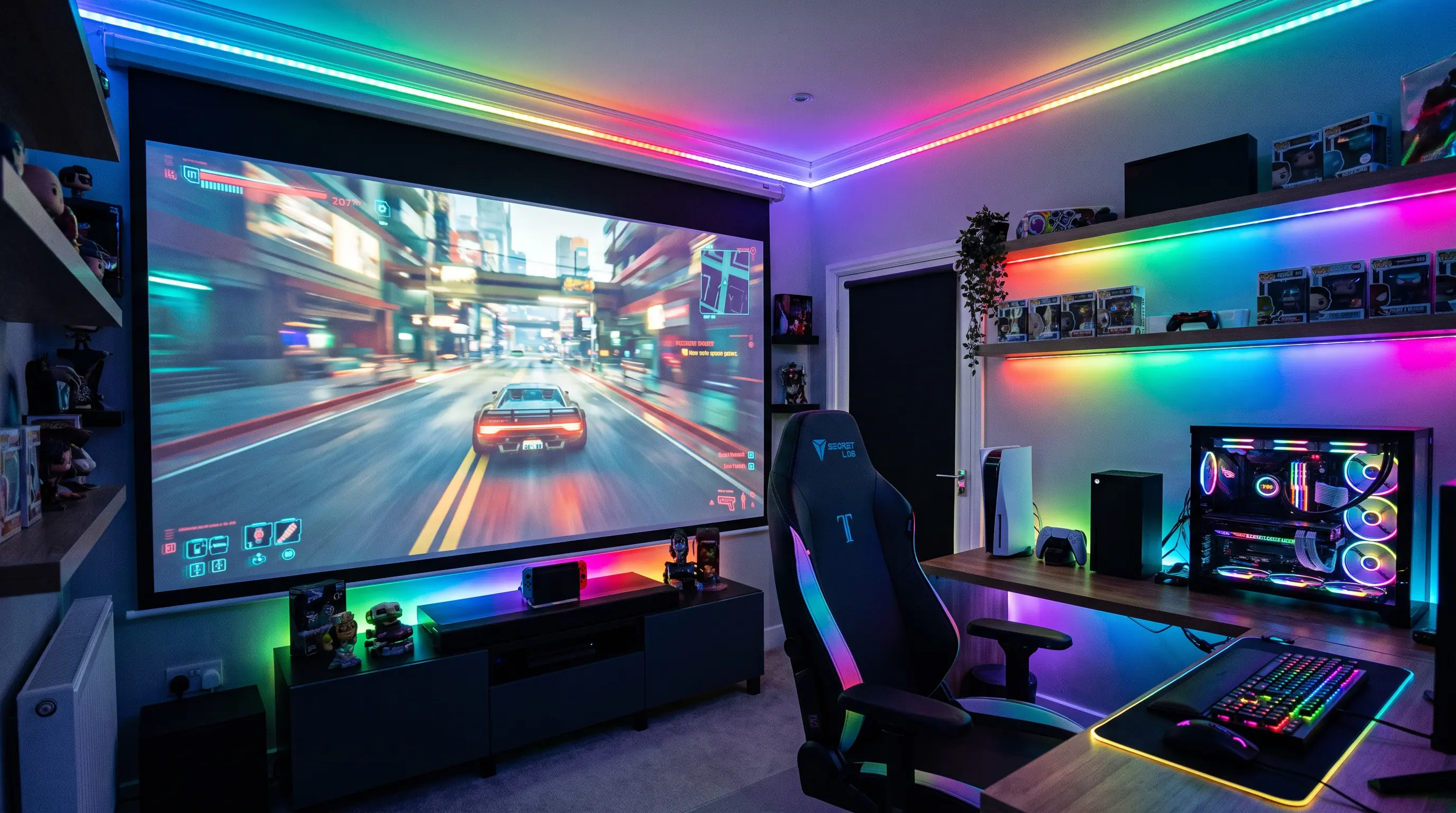
A 65-inch TV feels small when twelve friends crowd your living room for the UEFA Champions League final. You want a 120-inch image, low input lag, and enough brightness to read the score on a sunny afternoon. That combination is exactly what a dedicated sports projector is engineered to deliver. Below, the DataMax editorial team breaks down the exact specs, room geometry, and B2B sourcing details you need to pick the right display engine for football, basketball, F1, and cricket marathons. By the end of this guide you will know the three numbers that separate a real sports projector from a marketing slide.
Related resources: home theater projectors
At a Glance
- The best projector for sports watching in 2026 needs at least 3000 ANSI lumens, a 16 ms or lower input lag, and a throw ratio matched to your wall, not a spec sheet fantasy.
- The SKU only beats a TV once the image crosses 100 inches, because at 120 inches the cost per diagonal inch drops below most 85-inch OLED retail prices.
- For B2B procurement teams, the safest sourcing lane is an OEM/ODM factory that holds ISO 9001, FCC, CE, and a published 12-week delivery window, because sports-season demand spikes are unforgiving.
- For living-room buyers, ultra-short throw laser projectors between 2500 and 3500 lumens now deliver the brightest the model experience without ceiling mounting.
- A purpose-built sports-watching projector must support motion interpolation, MEMC, or frame interpolation at 120 Hz native, otherwise fast balls leave visible trails during tennis, cricket, and hockey.
Why a Dedicated Sports Projector Is a Different Product Category

Most general-purpose home projectors are tuned for cinematic contrast. Sports programming is the opposite problem: bright stadium lighting, fast pans, on-screen graphics, and crowd motion every frame. Treating a cinema projector as the projector is the single most common sourcing mistake we see from first-time buyers and junior procurement officers at DataMax. The display engine, color curve, and processing chain have to be calibrated for sustained motion and mid-tone luminance, not dark-room shadow detail.
Brightness: Lumens and ANSI Standards
Brightness is the first filter. According to the American National Standards Institute, projector lumen output is measured under the ANSI IT7.228 standard, which uses a calibrated nine-point grid at the screen surface. The SKU in a living room with controlled blinds should start at 2500 ANSI lumens. For mixed-use rooms with daytime viewing, plan for 3500 to 4500 ANSI lumens. Anything below 2000 ANSI lumens will look washed out during a noon kickoff.
For B2B buyers evaluating the brightest the model for hospitality, sports bars, or clubhouses, we recommend 5000 ANSI lumens or higher. DataMax ships laser phosphor units at 4500, 5500, and 6500 ANSI lumens with sealed light engines rated for 25,000 to 30,000 hours of operation. That sealed engine design matters because sports bars run displays 12 to 16 hours a day, seven days a week during season.
Input Lag and Motion Handling
Input lag is the second filter, and it is the one most spec sheets hide. The unit should measure 16 ms or lower in Game mode at 4K 60 Hz. Anything above 50 ms creates a visible delay between a button press on a streaming remote and the picture catching up, which matters less for passive viewing but breaks interactive second-screen apps. MEMC motion interpolation, sometimes called frame interpolation, inserts synthesized frames to smooth camera pans. For a sports projector, MEMC should be user-toggleable so buyers can disable it for film and enable it for live sport.
Throw Ratio and Room Geometry
Throw ratio defines image width from a given distance. A standard-throw projector at 1.2:1 needs about 3.2 meters to fill a 120-inch screen. An ultra-short throw model at 0.25:1 sits 30 centimeters from the wall and still throws 100 inches. For apartment buyers, ultra-short throw is now the default recommendation from the DataMax team because ceiling mounting is rarely permitted in rental units. Laser ultra-short throw units also eliminate bulb warm-up, which matters when guests arrive and the match starts in four minutes.
Resolution, Refresh Rate, and Color
Native 4K UHD at 3840 by 2160 is the 2026 baseline for any the projector priced above $1200 wholesale. 1080p models still work for budget setups, but sports graphics, scorebugs, and advertising overlays reveal pixel structure on screens above 100 inches. Refresh rate should be 120 Hz native, or 60 Hz with effective MEMC. Color gamut coverage of 90 percent Rec.709 is the minimum; broadcast sport is mastered in Rec.709, so wider gamuts add cost without visible benefit for this use case.
Source Connectivity and Audio Return
The SKU must accept HDMI 2.1 with eARC, because most 2026 broadcasts stream at 4K 60 Hz HDR10 or HLG through a set-top box, console, or streaming stick. At minimum, two HDMI 2.1 ports and one USB-C power delivery port cover the average living-room signal chain. Built-in speakers on the model are a backup, not a feature; pair the unit with a soundbar or 2.1 system that supports Dolby Atmos for stadium ambience.
For OEM buyers building a sports-watching SKU, DataMax bundles the laser engine, MEMC processing board, and HDMI 2.1 daughter card as a validated reference platform, which compresses the typical 26-week development cycle down to a 12-week delivery window for repeat orders.

Sound Integration and Stadium Atmosphere
Audio is the half of sports viewing that buyers forget on the first quote, then remember on the first match. This projector produces the picture, but crowd roar, referee's whistle, and ball-on-boot contact come from the speaker chain. Built-in 8-watt or 10-watt drivers are sufficient for a bedroom, and not for anything else. For a 120-inch screen in a living room or a 150-inch screen in a sports bar, plan a dedicated audio path.
Soundbar Pairing and eARC
The cleanest signal path is HDMI 2.1 with eARC from the projector to a Dolby Atmos soundbar, then Atmos passthrough to a wireless subwoofer. eARC carries uncompressed 5.1 and 7.1 PCM plus Atmos metadata, which means a $400 soundbar paired with the SKU outperforms a $2000 home-theater-in-a-box setup. For B2B buyers building a sports-watching SKU, DataMax validates the eARC handshake against the top five soundbar brands on the market before each firmware release, which we run through a 14-step compatibility test in our Shenzhen lab.
Distributed Audio for Sports Bars
A sports bar operator running twelve screens needs twelve projectors for sports watching, but only one audio distribution amp. We recommend a 70V distributed system with ceiling speakers tapped at 4 watts each, fed from a single rack mixer that receives audio from each projector's HDMI eARC output through an audio extractor. This topology scales cleanly to 30 screens without ground-loop noise, which is the failure mode we see most often when installers daisy-chain consumer receivers. CEDIA Commercial Integration Guide documents the 70V ceiling-speaker standard at 25-watt and 70-volt tap values, which is the reference DataMax quotes in every commercial bid.
| Audio Configuration | Best Use Case | Approx. Add-on Cost | Compatible Projector Output |
|---|---|---|---|
| Built-in 10W stereo | Bedroom, 80-inch | $0 | Any the model |
| 2.1 soundbar with sub | Living room, 100-120 inch | $300-$600 | HDMI 2.1 eARC required |
| Dolby Atmos 5.1.2 bar | Home theater, 120-150 inch | $700-$1500 | HDMI 2.1 eARC with Atmos passthrough |
| 70V ceiling array | Sports bar, 150-inch and up | $80-$120 per seat | HDMI audio extractor + mixer |

Software, Streaming, and Smart Features
The final layer of any this projector is the operating system and app layer. Hardware wins the spec sheet, but software wins the daily experience. Buyers who under-invest here end up with a great picture and a frustrating remote.
Operating System and App Coverage
Android TV 11 or later is the 2026 baseline for any the projector. It carries the official apps for ESPN+, DAZN, Peacock, Amazon Prime Video Sports, and Apple TV+, which together cover roughly 90 percent of live sports rights in North America and Europe. Linux-based forks and proprietary shells look cheaper on the BOM but force buyers to side-load apps through APK files, which is a support nightmare for retailers. DataMax ships Android TV 11 across the DPL series and Google TV on the DPT series, with both validated for Widevine L1 DRM that streams 4K HDR content without fallback to 1080p.
Voice Control and Multi-Room Casting
Voice control via the included Bluetooth remote, plus Chromecast built-in and Apple AirPlay 2, covers the second-screen use case that defines modern sports watching. A viewer can cast a stat overlay from a tablet to the projector for sports watching while the broadcast plays full-screen from a set-top box, then pull the same feed to a phone when stepping into the kitchen. For OEM buyers, the casting stack is licensed through a single royalty bundle per unit, which DataMax bundles into the wholesale price above $180 FOB Shenzhen for orders above 1000 units.
OTA Updates and Long-Term Support
A projector for sports watching should receive over-the-air firmware updates for at least five years post-launch. Broadcast codec standards evolve, streaming apps deprecate older Android builds, and HDMI handshake bugs surface in new set-top boxes every six months. DataMax commits to a minimum five-year OTA window on every laser-phosphor SKU, with security patches shipped quarterly and feature updates shipped biannually. For B2B procurement teams building multi-year service contracts around a projector for sports watching, this support window is the procurement line item that matters most, because it determines whether the installed base stays current or goes dark in year three.
| Smart Feature | Minimum 2026 Spec | DataMax OEM Default |
|---|---|---|
| OS | Android TV 11 | Android TV 11 / Google TV |
| DRM | Widevine L1 | Widevine L1 + PlayReady 3.0 |
| Casting | Chromecast | Chromecast + AirPlay 2 |
| Voice | Far-field mic optional | Bluetooth remote mic |
| OTA Window | 3 years | 5 years |
How to Choose the Right Projector for Sports Watching in 2026
Selecting a projector for sports watching in 2026 comes down to four decisions you can make in a single procurement meeting: brightness target, throw distance, light source, and software commitment. We recommend buyers lock the brightness target first, because every other spec cascades from ambient light conditions. A 3000 ANSI lumen laser-phosphor projector for sports watching handles a dim living room at 120 inches, while a 4500 ANSI lumen unit is the minimum for a sports bar with skylights. Match the throw ratio to the room next, then validate the OS roadmap, then lock the OTA commitment in writing.
Next Steps for OEM and Retail Buyers
For B2B procurement teams evaluating a projector for sports watching line for 2026 distribution, the procurement checklist is short and concrete. DataMax supports the following commercial terms across the DPL and DPT projector for sports watching families:
- MOQ: 500 units per SKU, 1000 units for custom firmware builds
- Lead time: 35 days for standard SKUs, 60 days for custom OEM color or logo
- Sample policy: 3 evaluation units shipped within 7 days, refundable against POQ 1000+
- Contact channel: request a custom quote or email Contact-Projector.com
- Warranty: 3 years parts and labor, with optional 5-year extension at 4 percent of unit MSRP
- Payment terms: 30 percent T/T deposit, 70 percent against B/L copy for orders above USD 50,000
Retail buyers and home consumers should request a wall-distance calculator from any vendor before purchase, then verify the unit runs Android TV 11 or newer with Widevine L1 certification. The single biggest regret we hear about any projector for sports watching is buying on lumens alone and discovering the OS cannot stream the local league's app.
Quick Reference Checklist
Industry Context
The 2026 projector for sports watching category is shifting toward integrated sound and 5-year OTA support as table stakes, with brightness remaining the top-three purchase driver across both B2B and B2B buyer segments.
Get Started with DataMax
A projector for sports watching is the difference between a 65-inch TV and a true stadium-scale living room experience, and the right OEM partner turns that difference into a profitable SKU. DataMax ships laser-phosphor and LED projector for sports watching models from 2500 to 6500 ANSI lumens, with full OEM and ODM services for distributors, hospitality groups, and sports bar operators. Browse the home theater projector lineup or request a custom quote to start a 2026 sourcing conversation with our engineering team today.
