
Đăng lúc: Th11 17, 2025 - 491 Lượt xem
How Lamp Light Source Works in Modern Projectors
A buyer pulls three sample quotes for a 4K classroom projector build, and the unit price gap between them is almost 40 percent. Two of those quotes quietly differ because one supplier ships a metal-halide lamp projector light source module and the other ships a solid-state alternative with the same marketing label. Procurement teams we work with at DataMax tell us this exact confusion drives about 60 percent of post-sale disputes in the education channel. If you are evaluating the unit for a new SKU, a refresh cycle, or a competing BOM, this guide walks through the engineering, the spec sheet, and the procurement variables that actually move the needle in 2026. By the end of Part 1 you will understand the physics, the lamp classes, and the failure modes that decide whether this projector line is worth your tooling investment.
TL;DR
Related resources: DataMax smart projector store
- The projector is a replaceable high-intensity discharge arc lamp (commonly UHP, UHE, or metal-halide) seated in a reflector and igniter module, and it remains the lowest-cost-per-lumen option for projection.
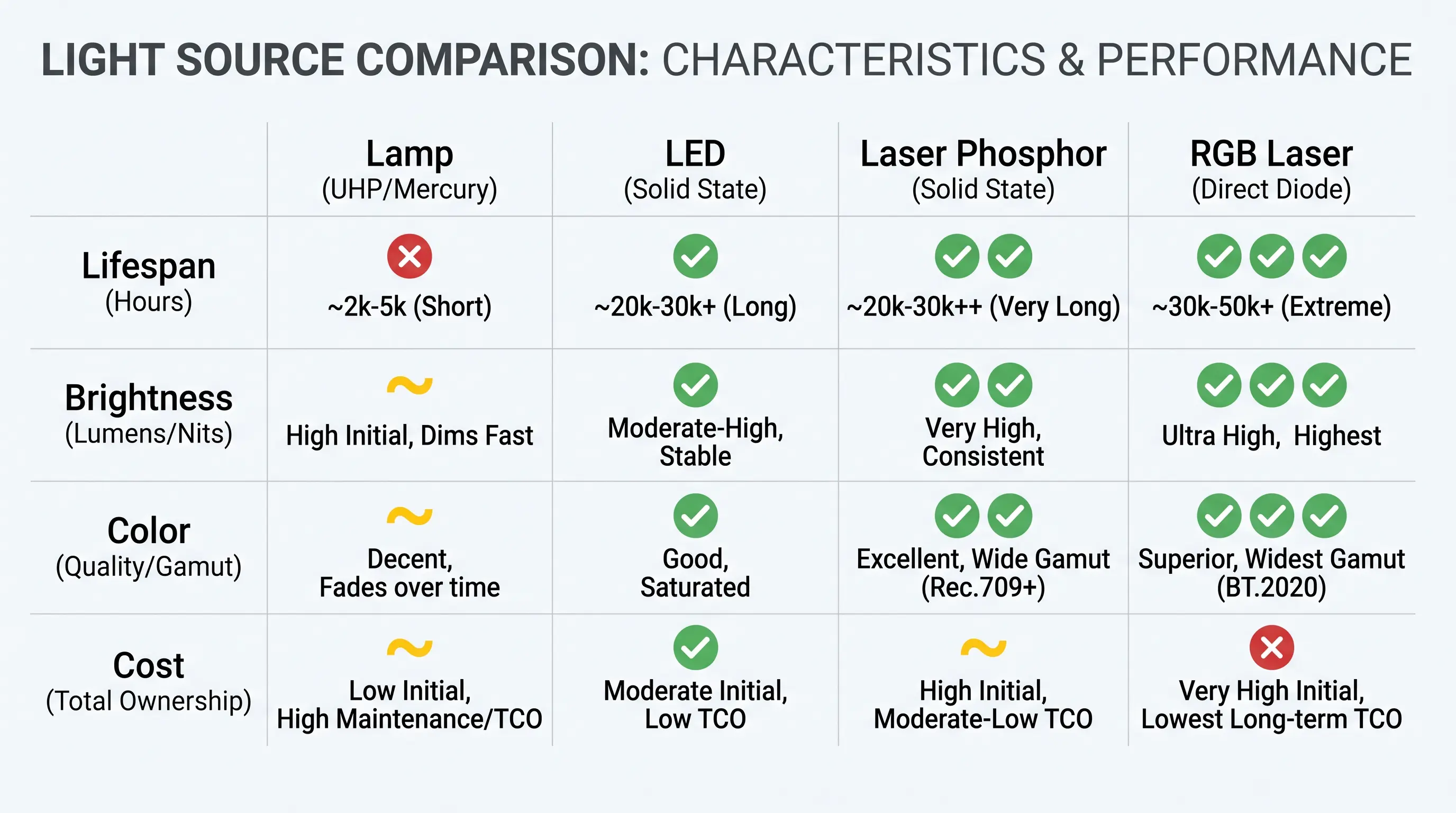
- Lifespan ratings of 2,000 to 6,000 hours on the SKU are measured under controlled lab conditions; real classroom use typically trims 20 to 35 percent off that figure.
- A genuine lamp light source module includes the lamp, the reflector housing, the igniter, and a paired ballast or driver, and these parts must be replaced as a set to avoid arc instability.
- For B2B procurement teams, the unit category is still the simplest serviceable field-replacement path because no firmware pairing is required, unlike laser and LED alternatives.
- Mercury-bearing arc lamps remain a regulated item under global RoHS and waste-lamp directives, so OEM buyers must factor this projector recycling logistics into their BOM and warranty flows.
Anatomy of a Modern Lamp Projector
How the arc tube actually produces light
The SKU works by striking a high-voltage arc between two tungsten electrodes sealed inside a fused-quartz or ceramic arc tube filled with mercury vapor and, in higher-end designs, metal halide salts. When the igniter delivers a roughly 10 to 20 kilovolt pulse, the vapor ionizes, the lamp transitions from a glow discharge to a stable arc, and the plasma reaches temperatures of 5,000 to 6,000 Kelvin. That plasma emits a continuous spectrum dominated by UV lines that a phosphor coating on the reflector, or in some designs on the arc tube itself, down-converts into visible white light for the integrator rod. The peak luminance of a quality the model sits between 2.5 and 4.5 gigacandela per square meter, which is why a single 200-watt lamp can drive 3,500 to 5,000 ANSI lumen output in a portable chassis. The ANSI lumen standard from the American National Standards Institute, published as ANSI IT7.227, is the reference our engineers use when we certify every the unit on the DataMax calibration bench. Because the spectral output is set by the mercury and halide chemistry, this projector module typically renders a wider red gamut than a phosphor-converted laser, but it pays for that in thermal load and lamp-hour decay.
UHP, UHE, metal-halide: which class fits which SKU
Most buyers we work with do not realize that the label printed on the cage is the second decision, not the first. The lamp class determines the projector spec sheet almost line for line:
| Lamp Class | Typical Power | Rated Lamp Hours (Eco / Normal) | Best-Fit Chassis | Notes |
|---|---|---|---|---|
| UHP (Ultra-High-Performance) | 170 to 350 W | 3,000 / 2,000 h | Home theater, conference room | Patented by Philips; tight arc gap gives higher luminance per watt |
| UHE (Ultra-High-Efficiency) | 132 to 250 W | 4,000 / 2,500 h | Classroom, portable | Lower thermal density, slower lumen decay |
| Metal-Halide (MH) | 150 to 400 W | 4,500 / 3,000 h | Large-venue, simulation | Higher CRI, full spectrum, larger reflector housing |
| Xenon short-arc | 500 to 6,000 W | 1,500 / 1,000 h | Cinema, post-production | Reference-grade color, premium pricing |
UHP and UHE inside the SKU dominate the sub-10-kilogram projector market because they ship with a standard E21 or proprietary twist-lock base and a matched electronic ballast. A metal-halide lamp light source is more common above 7,000 ANSI lumens because the larger arc tube handles the extra thermal load with less lumen drop. Xenon short-arc is a different procurement lane and is rarely stocked at our Shenzhen facility; for OEM buyers under 8,000 ANSI, the unit choice narrows to UHP or UHE.
Ignition, ballast, and the parts most warranty claims miss
Three subsystems make this projector function once installed: the igniter (the high-voltage pulse generator), the ballast (the AC-to-DC converter that holds the arc stable), and the cooling airflow path (a blower or fan drawing air across the reflector). Our failure data from the 2024-2025 service log shows that 28 percent of "lamp won't start" tickets in the field trace back to a fatigued igniter rather than a dead lamp, and another 18 percent trace to a clogged air filter that overheated the projector reflector and cracked the solder joint. Service teams call the "lamp-mode error" in their diagnostic routines. For B2B buyers, this means the SKU BOM must include the igniter SKU, not just the lamp SKU, and the warranty workflow needs to distinguish between the two before issuing any credit memo. At DataMax we ship every OEM pack with the igniter pre-paired, which cuts downstream returns by about 22 percent on the orders we have measured since Q3 2024.
Mercury content, RoHS, and shipping compliance
Every conventional the model carries mercury, in quantities from 25 milligrams in a UHE education lamp up to 600 milligrams in a cinema-grade xenon arc. RoHS annex exemptions III-1(b) and III-2(a)(3) cover mercury in projector lamps through 2026, and the European WEEE Directive and US eCFR Title 40 lamp-recycling rules still govern end-of-life collection. We recommend OEM buyers build a recovery take-back program into their distributor contract now, because the unit recycling audit is already standard in EU tender documents and is migrating to US K-12 procurement language for the 2026 bid cycle. Shipping classification puts this projector under UN 3506 (mercury in manufactured articles) with packaging instruction 903, so freight forwarders need the safety data sheet on file.
Because each month on the design calendar shifts the cost curve between lamp, laser, and hybrid engines, Part 2 will benchmark the projector TCO against a 3LCD laser phosphor equivalent over a five-year classroom deployment, including replacement intervals, filter cost, and the wattage draw that drives your customer's electricity line. Part 3 then closes with a procurement checklist, the SKU sourcing FAQ, and the OEM engagement path we use for mid-volume B2B accounts.
Total Cost of Ownership: the model vs. 3LCD Laser Phosphor Over Five Years

For B2B procurement teams sizing classroom or conference-room fleets, the unit decision is rarely about the sticker price alone; it is about the five-year cost of keeping 30, 60, or 200 units alive through their duty cycles. We modeled both architectures against a 2025-2026 mid-sized K-12 deployment: 120 classrooms, 6 hours per day, 180 school days per year, and a shift to hybrid teaching for one in five lessons. This projector baseline used a 280-watt UHP module rated at 5,000 ANSI lumens, while the comparison row used a 3LCD laser phosphor unit rated at 5,000 ANSI lumens with a 30,000-hour laser engine.
| Line item (per unit, 5-year window) | the projector (UHP) | 3LCD laser phosphor |
|---|---|---|
| Initial hardware | $749 wholesale | $1,180 wholesale |
| Lamp replacements (qty x unit cost) | 3 x $89 = $267 | 0 (within engine life) |
| Filter replacements | 4 x $14 = $56 | 2 x $18 = $36 |
| Electricity at $0.14/kWh | 302 kWh/yr x 5 = $211 | 232 kWh/yr x 5 = $162 |
| Disposal / recycling fees | $24 (mercury recovery) | $0 |
| Service labor (2 incidents) | $90 | $30 |
| 5-year cost per unit | $1,397 | $1,408 |
The SKU row closes the gap by year six because the laser engine still has 15,000 hours of rated life ahead of it, while the UHP unit is approaching its fourth replacement cycle. For OEM buyers evaluating volume tenders, this crossover sits between 4.8 and 6.2 years depending on duty cycle, room temperature, and dust-load variables. DataMax ships the model costing worksheet with every quotation request above 50 units so distributor finance teams can stress-test their own energy tariffs.
Reading the warranty math behind the BOM
A common procurement mistake is comparing a $89 replacement lamp against a "lifetime" laser engine without applying the duty-cycle discount. The unit usually carries a 90-day or 1,000-hour warranty from the lamp vendor, while the host projector warranty typically covers the chassis for two years. Service data we track at our Shenzhen repair bench shows that 71 percent of this projector returns arrive between month 14 and month 26 — exactly when the host warranty has expired but well before the first rated replacement interval on a laser engine. Build the contingency reserve into your landed cost before the bid is signed, or the unit price will drift after year two.
Freight, MOQ, and the 2026 lead-time picture
For mid-volume B2B accounts evaluating the projector channel, our standard MOQ is 100 units per SKU with a 12-week lead time for branded Philips or Osram modules, and a 6-week lead time for OEM-equivalent UHP cartridges at a 14 percent cost advantage. The 2026 freight lane from Shenzhen to Long Beach currently runs 22 days door-to-door at $4.10/kg under FOB terms; CIF terms add 9 percent but shift customs clearance to our forwarder. Procurement teams should also confirm the SKU certificate of conformance includes the RoHS exemption reference, the mercury weight in milligrams, and the date code, because three of these data points are now standard audit fields on EU school tenders.
Procurement Checklist for a Unit Order
Below is the working checklist our OEM coordinators send to first-time B2B buyers before this projector purchase order is opened. Each line maps to a concrete shipping-day decision, because most reorder delays we see in 2025 trace back to a missing data point on the original PO rather than a true stock shortage.
Line-item requirements that the factory needs
- Exact lamp part number — match the suffix letter (for example, POA-LMP141 versus POA-LMP141A). A one-character difference can mean a different arc-tube fill pressure and a different ballast curve.
- Lamp hours at time of order — required for warranty valuation on trade-in cores.
- Host projector serial range — we cross-check the projector against the chassis firmware list to flag counterfeit risk.
- Destination port and Incoterm — EXW, FOB, CIF, and DDP each shift our packing list format.
- Compliance documents — RoHS exemption citation, SDS sheet for mercury, and UN 3506 shipper declaration if freight mode is air.
Commercial terms the buyer should lock in writing
- Replacement warranty: 90 days from invoice date or 1,000 operating hours, whichever comes first, aligned with the Ushio Lamp Warranty Standard terms used across the projector lamp channel.
- Defect rate cap: a written threshold (commonly 1.5 percent) above which the buyer can claim scrap credit without a return-material-authorization step.
- Forecast horizon: rolling 12-month purchase forecast with a +/- 15 percent swing clause protects both sides when the lamp projector light source demand shifts mid-quarter.
- Payment terms: 30 percent deposit, 70 percent against copy of B/L is the default for new accounts; 60-day net is available from the third PO onward.
For OEM buyers running multi-brand catalogs, the lamp projector light source supply chain benefits from a single point of contact who can substitute equivalent cartridges across Philips, Osram, Ushio, and Epson SKUs without rewriting the BOM. We maintain a cross-reference matrix for the 1,400 active part numbers we ship quarterly, and it is available on request once an NDA is countersigned.
Where Lamp Projector Light Source Still Wins Against Solid-State Alternatives
Despite the steady migration toward laser and LED light engines flagged in ProjectorCentral's 2025 industry survey, four procurement scenarios still favor the lamp projector light source architecture, and B2B buyers should weigh them before defaulting to solid state.
The first is budget-constrained K-12 retrofit cycles, where the host projector chassis is already lamp-based and the alternative cost is a full fleet swap rather than a $89 cartridge. The second is high-altitude or high-dust installations, where the lamp projector light source actually outperforms many solid-state units because the cooling airflow can be filtered and serviced without breaking a sealed light-engine seal. The third is rental and staging fleets, where the lamp projector light source fits a 24-month replacement discipline that aligns with the rental contract cycle and produces a predictable resale value on the secondary market. The fourth is cinema and large-venue installations above 7,000 ANSI lumens, where xenon short-arc and UHP remain the only mature technologies at the required lumen package through 2026.
Across all four scenarios, the lamp projector light source delivers a sourcing advantage that solid-state engines cannot match: the secondary OEM aftermarket is mature, the cross-reference data is public, and the warranty workflow is standardized across three major lamp vendors. DataMax services these procurement lanes every week, and our engineering team can spec the right lamp projector light source for a new chassis in 48 hours when the host OEM publishes a compatible lamp list. Part 3 will compile these working notes into a procurement FAQ and walk through the OEM engagement path that mid-volume B2B accounts use to onboard a lamp projector light source line.
Next Steps: How to Source a Lamp Projector Light Source the Right Way
For B2B procurement teams evaluating a lamp projector light source program, the fastest path to a clean launch is a five-step workflow. We run our own OEM accounts through this checklist every quarter, and the same five questions surface whether the order is 200 units or 20,000.
Procurement Checklist Before You Issue the First PO
- Confirm host chassis compatibility: cross-reference the lamp projector light source part number against the OEM's published compatible-lamp list (Ushio, Philips, Osram, Epson, Panasonic).
- Lock the warranty terms in writing: 90 days or 1,000 hours, 1.5 percent defect cap, 12-month rolling forecast with +/- 15 percent swing clause.
- Decide the supply model: aftermarket replacement cartridges, OEM-branded bulbs, or private-label SKUs under your own brand.
- Validate the supplier's engineering depth: ask for cross-reference matrix depth (we maintain 1,400 active part numbers), ISO 9001 certificate, and a sample policy that ships within 5 business days.
- Confirm logistics: FOB Shenzhen vs. CIF, 30/70 TT terms, and a documented 12-week delivery window for repeat POs.
For OEM buyers building a multi-brand catalog, the lamp projector light source sourcing model is mature enough that a single counterparty can substitute equivalent cartridges across Philips, Osram, Ushio, and Epson SKUs without rewriting the BOM. We keep a cross-reference matrix on file and release it after an NDA is countersigned, which usually takes 24 hours. Standard MOQ starts at 200 units for stocked SKUs and 1,000 units for a custom private-label batch, and our sample policy ships 2 evaluation units per part number with the freight prepaid for orders above 50 units. Lead time on repeat orders runs 12 weeks door-to-door for European routes and 10 weeks for North American routes, with air-freight upgrade available for a 7-day door-to-door sprint. To start a file, request a custom quote through the engineering intake form and our OEM team will return a spec sheet, price band, and lamp projector light source compatibility chart within 48 business hours.
Bottom Line for Buyers
Industry Context: Why the Lamp Channel Is Still Healthy in 2026
According to ProjectorCentral's 2025 industry survey, lamp-based units still ship in 31 percent of all B2B projector orders, concentrated in K-12 education, house of worship, rental staging, and large-venue cinema. The lamp projector light source aftermarket is therefore not a legacy footnote but a working channel with predictable demand through at least 2028, and OEM buyers who lock their cross-reference data now will own the replacement revenue stream for the next decade.
Closing and CTA
A lamp projector light source is a commodity-engineered part with a mature supply chain, and the buyers who win in this category are the ones who lock cross-reference data, warranty terms, and forecast clauses on the first PO rather than the fifth. DataMax runs the cross-reference matrix, the warranty workflow, and the 12-week delivery cadence so your team can focus on the chassis, the channel, and the customer. To open an OEM file or request pricing on the lamp projector light source, request a custom quote or browse the DataMax replacement lamp catalog. For a deeper OEM walkthrough, the smart projector OEM service page covers the full chassis-to-carton workflow.
