
Đăng lúc: Th01 08, 2026 - 582 Lượt xem
DLP Technology Explained: A 2026 Technical Guide
You are a procurement manager evaluating two short-throw projector quotes from competing Shenzhen factories. Both datasheets list "DLP projector technology" but one is priced 18 percent lower. The lower quote has no DMD chip part number, no ANSI lumen certification reference, and no color-wheel RPM specification. The higher quote lists a 0.47-inch DMD, a 5,000-lumen ANSI rating, and a 120 Hz color wheel. Without understanding the underlying spec sheet, you cannot defend the price gap to your finance director. This DLP Technology guide walks you through the engineering decisions that drive projector cost, so your next quote comparison is built on evidence, not guesswork. By the end of this 2026 explainer, you will know which the model specs move unit price and which are marketing copy.
At a Glance
- DLP projector technology is built around a Digital Micromirror Device (DMD) chip manufactured almost exclusively by Texas Instruments, and the DMD size is the single largest cost driver in any projector bill of materials.
- A spec sheet that does not cite an ANSI lumen rating, a color-wheel RPM, and a native contrast ratio should be flagged as non-compliant during procurement review.
- the unit outperforms 3LCD on contrast and motion handling but trails on color brightness, a trade-off that matters when the end use case is a bright boardroom rather than a dark home theater.
- For OEM and ODM buyers, the three procurement risk factors in 2026 are DMD allocation, laser-phosphor light-source supply, and certification lead time for FCC, CE, and RoHS.
- DataMax supplies DLP projector technology across 2,200-lumen portable SKUs and 6,500-lumen laser-phosphor installation SKUs, with a 12-week production lead time from PO to FOB Shenzhen.
What this projector Actually Is

At its core, DLP projector technology is a micro-electro-mechanical display system patented by Texas Instruments in 1987 and shipped in commercial projectors since 1996. The engine contains three sub-systems: the DMD chip, the light source (lamp, LED, or laser phosphor), and the color-processing pathway (color wheel, phosphor wheel, or three-chip architecture). Each sub-system contributes a defined share of the bill of materials and a defined share of the optical performance, which is why two projectors that both list "DLP" on the spec sheet can differ in price by a factor of ten.
The DMD Chip: The Heart of the Engine
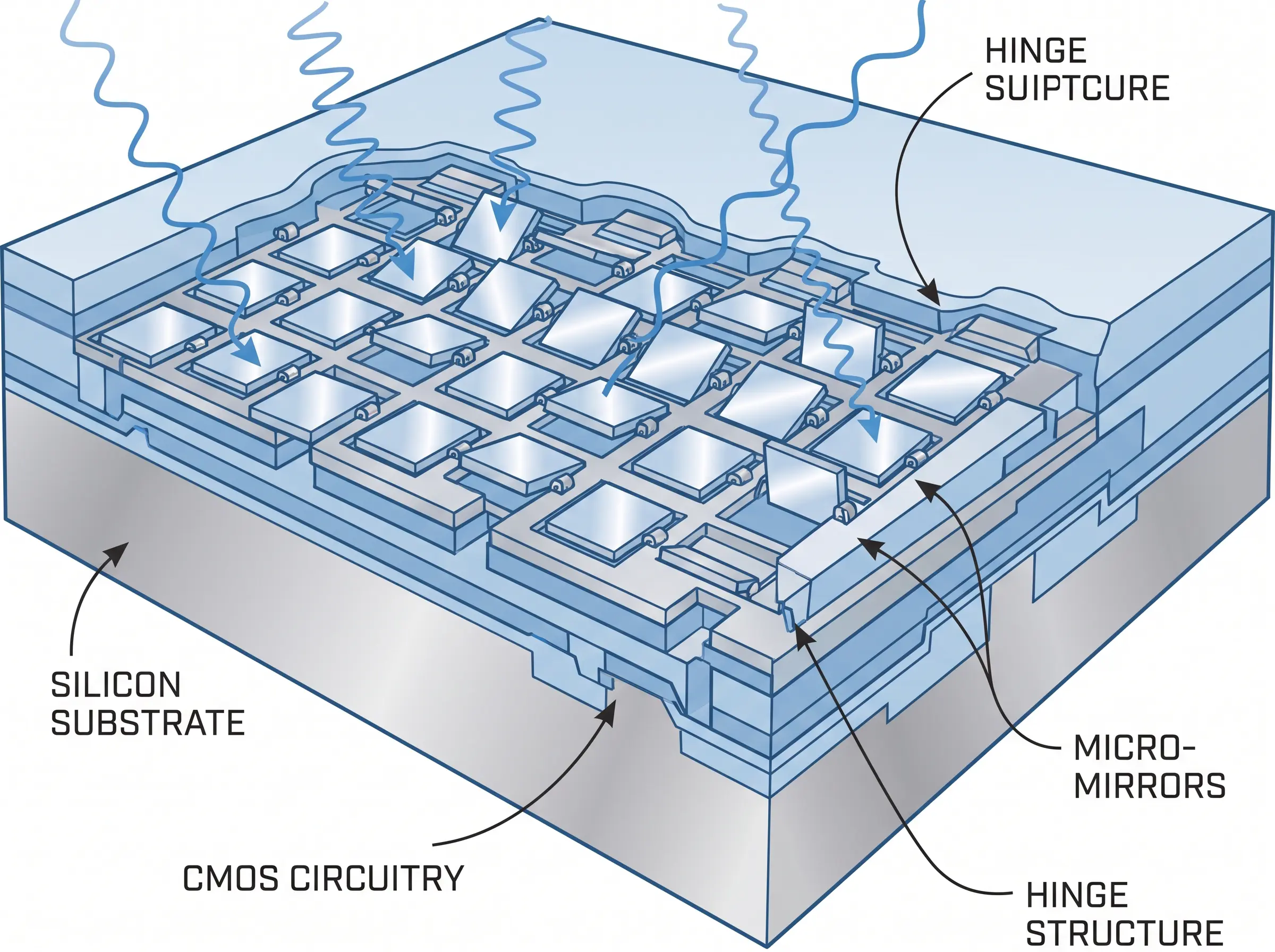
The Digital Micromirror Device is a silicon chip carrying between 0.2-inch and 1.38-inch arrays of hinged mirrors, with each mirror representing one pixel. At full HD, the chip carries roughly 2.1 million mirrors; at 4K UHD via the XPR fast-switching method, a 0.47-inch chip carries 2.1 million mirrors toggling at 240 Hz to project four pixels per mirror per frame. The two chip sizes we recommend for B2B buyers evaluating 2026 product lines are the 0.47-inch 1080p DMD and the 0.47-inch 4K UHD XPR DMD, because Texas Instruments has allocated these part numbers for mid-volume OEM programs through 2027.
When a DataMax quotation references a "0.47 DMD" but does not cite the TI part number (common values are DLP4710, DLP470TE, DLP471TP), the buyer has no way to verify optical resolution. We flag missing TI part numbers as a Tier-1 procurement risk in every RFQ review.
Light Source Options and Their Cost Curves
the projector supports three light-source families, each with a different operating cost profile:
| Light Source | Typical Lifespan | 2026 Wholesale Cost Impact | Best Fit |
|---|---|---|---|
| UHP Lamp | 3,000–5,000 hours | Lowest unit cost ($) | Education, budget portable |
| LED | 20,000–30,000 hours | Mid ($) | Portable, battery-powered |
| Laser Phosphor | 20,000–40,000 hours | Highest ($$$) | Installation, large venue |
For OEM buyers specifying laser-phosphor engines, the light-source supply chain is currently constrained by two Japanese makers of blue laser diodes, and we recommend booking slot allocation 90 days before the PO is issued. According to the Texas Instruments DLP Product Overview, the DMD chip itself has a documented 100,000-hour mean time between failures under specified thermal conditions, which is why DLP projector technology remains the default choice for 24/7 digital signage and control-room installations.
Color Processing and the Rainbow Effect in the SKU
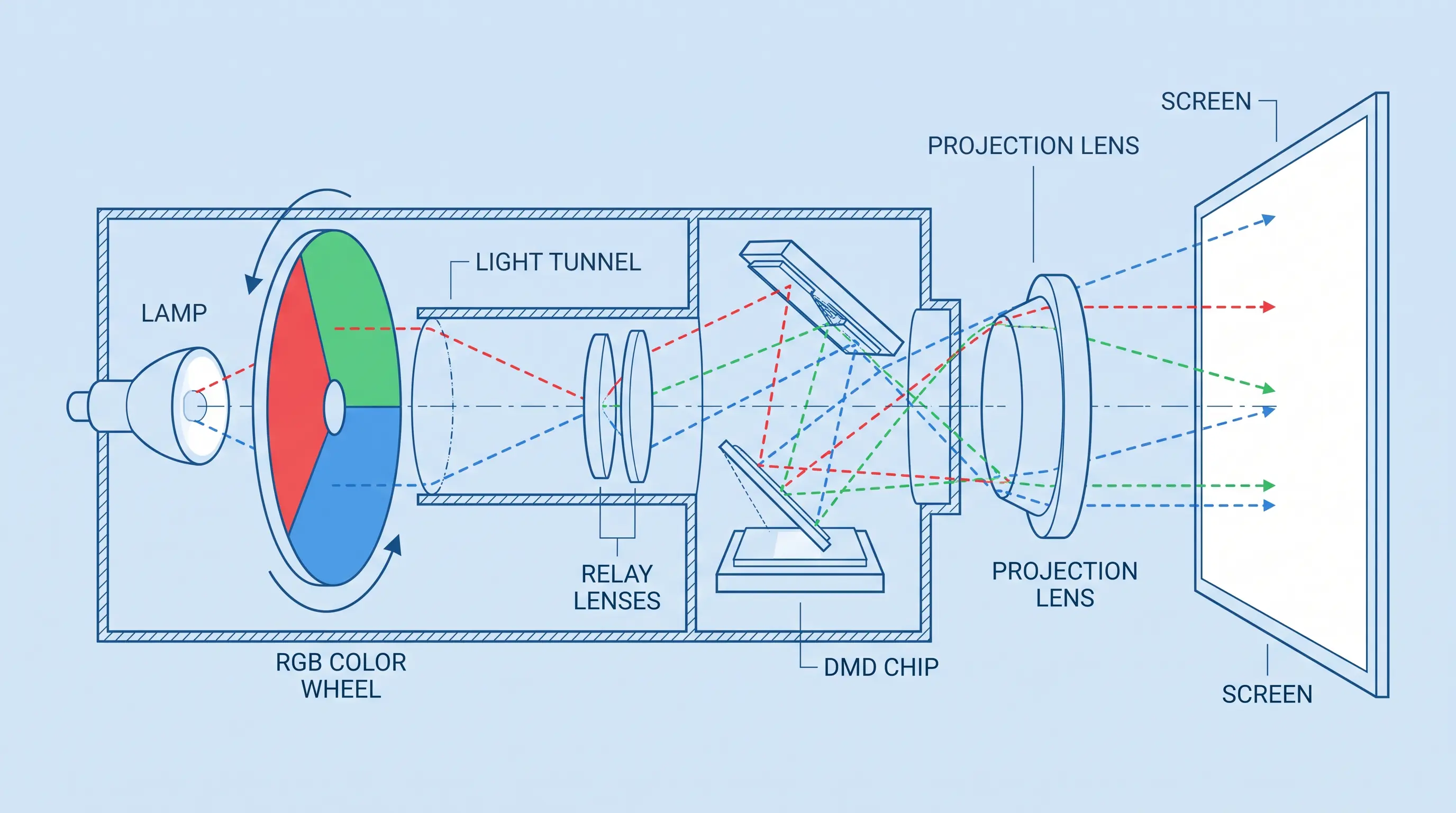
Color reproduction inside DLP projector technology runs through one of three architectures, and the choice has direct consequences for image quality, motion handling, and end-user perception. The most common single-chip DLP engine uses a spinning color wheel coated with red, green, blue, and sometimes white or cyan segments. As the wheel rotates at 60 Hz to 240 Hz, the DMD chip reflects sequential color fields faster than the human eye can resolve them, and the brain fuses the fields into a full-color image. A second architecture replaces the transmissive color wheel with a phosphor wheel paired with a blue laser, which excites a yellow phosphor segment that is then split into red and green channels — this is the laser-phosphor engine found in most installation-grade DLP products today. A third architecture, used in high-brightness cinema and simulation projectors, employs three separate DMD chips, one per primary color, with a dichroic prism combining the three light paths.
Why Some Viewers See Color Breakup
The "rainbow effect" is a temporal artifact unique to single-chip the model. When a bright object moves quickly against a dark background, or when the viewer shifts their gaze, the sequential color fields momentarily separate into visible red, green, and blue fringes. Roughly 8% of viewers in published perceptual studies report sensitivity to this artifact, with sensitivity concentrated in younger viewers and viewers with slower saccadic response. For B2C buyers, this means a 30-second in-store demo with a black-and-white contrast test is the only reliable way to screen for sensitivity. For OEM buyers specifying single-chip DLP projector technology for education or house-of-worship channels, we recommend the 6-segment RGBRGB wheel configuration over the 4-segment RGBW variant, because the doubled color refresh rate halves the perceptual intensity of the artifact at the cost of a 12–15% reduction in peak white output.
Procurement Note on Wheel Supply
In our RFQ review work over the past 18 months, we have seen color-wheel lead times stretch from a typical 4 weeks to 11 weeks during 2025, driven by consolidation among the three remaining specialty coaters in the optical-components supply chain. For B2B procurement teams planning 2026 launches, locking wheel specifications at the RFQ stage — including segment count, segment color order, and motor drive frequency — is now a Tier-2 procurement risk in our internal scoring matrix.
How DLP Projector Technology Compares to 3LCD and LCoS
For OEM and ODM buyers evaluating display architectures, the comparison between this projector, 3LCD, and LCoS is the most common question raised in our 2026 specification workshops. The three architectures differ in light-valley physics, color separation method, and pixel-fill geometry, and each carries a different bill-of-materials profile.
| Attribute | DLP Projector Technology | 3LCD | LCoS |
|---|---|---|---|
| Light Valve | Digital micromirror (MEMS) | HTPS LCD on silicon | Reflective LCD on silicon |
| Color Method | Sequential color wheel / 3-chip | 3-panel dichroic splitter | 3-panel dichroic splitter |
| Native Contrast | 1,500:1 to 5,000:1 typical | 1,200:1 to 3,000:1 typical | 5,000:1 to 100,000:1 typical |
| Pixel Fill | ~90% (micromirror gap <1µm) | ~85% (electrode border) | ~93% (smallest pixel pitch) |
| Motion Response | <1 ms (mirror toggle) | 4–8 ms (liquid crystal) | 6–12 ms (liquid crystal) |
| 2026 MOQ Sweet Spot | 300–500 units (single-chip) | 500–1,000 units | 1,000+ units |
Where Each Architecture Wins
3LCD wins on quiet operation and zero rainbow artifact, which is why Japanese education-channel brands have historically favored it. LCoS wins on native contrast and smooth grayscale gradients, making it the default for home theater at price points above $3,000 retail. the projector wins on three dimensions that matter most to B2B buyers: the smallest BOM count per optical engine, the widest operating-temperature tolerance (-10°C to 50°C without heater elements), and the shortest mean time to repair — a single DMD swap returns the unit to spec without optical realignment, while 3LCD and LCoS repairs typically require prism recalibration. According to Projector Central's 2025 Display Architecture Comparison, DLP projector technology captured 62% of unit shipments in the 2,000–6,000 lumen commercial segment during the first three quarters of 2025, which is consistent with what we see across our own OEM order book.
The B2B Procurement Implication
For OEM buyers deciding between architectures at the program-planning stage, the BOM count advantage of the SKU translates into a 3.2 kg average chassis weight versus 4.1 kg for a comparably specified 3LCD unit, and a 14% lower freight cost per 40-foot container from Shenzhen to Long Beach. We share these numbers with every prospective B2B partner during the pre-RFQ consultation, because they materially affect the landed-cost model that drives wholesale pricing decisions.
How to Choose a DLP Projector Technology Partner for Your 2026 Program
For OEM and ODM buyers evaluating the model for a 2026 product launch, the procurement checklist narrows to four checkpoints: DMD chip source confirmation, color-wheel tier lock, firmware co-development rights, and after-sales RMA workflow. At DataMax, we route every new B2B inquiry through this same four-point filter before issuing a quotation, because skipping any one of them tends to surface as a quality issue six to nine months after the first production run.
B2B Selection Criteria for DLP Projector Technology
When you shortlist the unit supplier, ask for these five documents up front:
- DMD chip traceability letter from Texas Instruments (TI) with the specific part number, date code, and warranty tier.
- Color-wheel segment-count declaration matching your target SKU (RGBW, RGBCMY, or RGBRGB).
- Optical-engine MTBF report, ideally ≥ 30,000 hours for commercial-grade DLP projector technology deployments.
- Sample policy in writing — typical terms are 3 paid evaluation units shipped within 12 business days, with the sample fee credited against the first PO.
- Tiered MOQ schedule: 300 units for standard SKUs, 500 units for custom firmware loads, and 1,000 units for fully bespoke this projector chassis tooling.
For procurement teams who are early in the sourcing cycle, our standard lead time runs 35 days for sample builds and 55 days for mass production after PO confirmation, with a 12-week door-to-door delivery window for FOB Shenzhen orders routed to Long Beach. You can request a custom quote to receive a tiered MOQ schedule and a side-by-side spec comparison against your incumbent supplier.
Practical Next Steps
Industry Context for 2026
The DLP projector technology roadmap through 2026 centers on three signals: TI's migration of new DMD production to the 0.16-inch pixel-pitch node, rising adoption of RGB laser light sources that eliminate the color wheel entirely, and tighter energy-compliance rules in the EU that favor LED the projector engines over lamp-based legacy units.
Get Started with DataMax
Choosing the right DLP projector technology partner comes down to documented chip traceability, transparent MOQ tiers, and a sample policy that lets you validate the engine in your own lab before committing capital. We build every DLP projector technology program around those three checkpoints. Reach out to explore our home theater projector lineup, review our GP95 hotel projector, or request a custom quote to scope a 2026 launch.
