
Đăng lúc: Th02 09, 2026 - 219 Lượt xem
Best Projector for Conference in 2026: A Complete Buyer's Guide
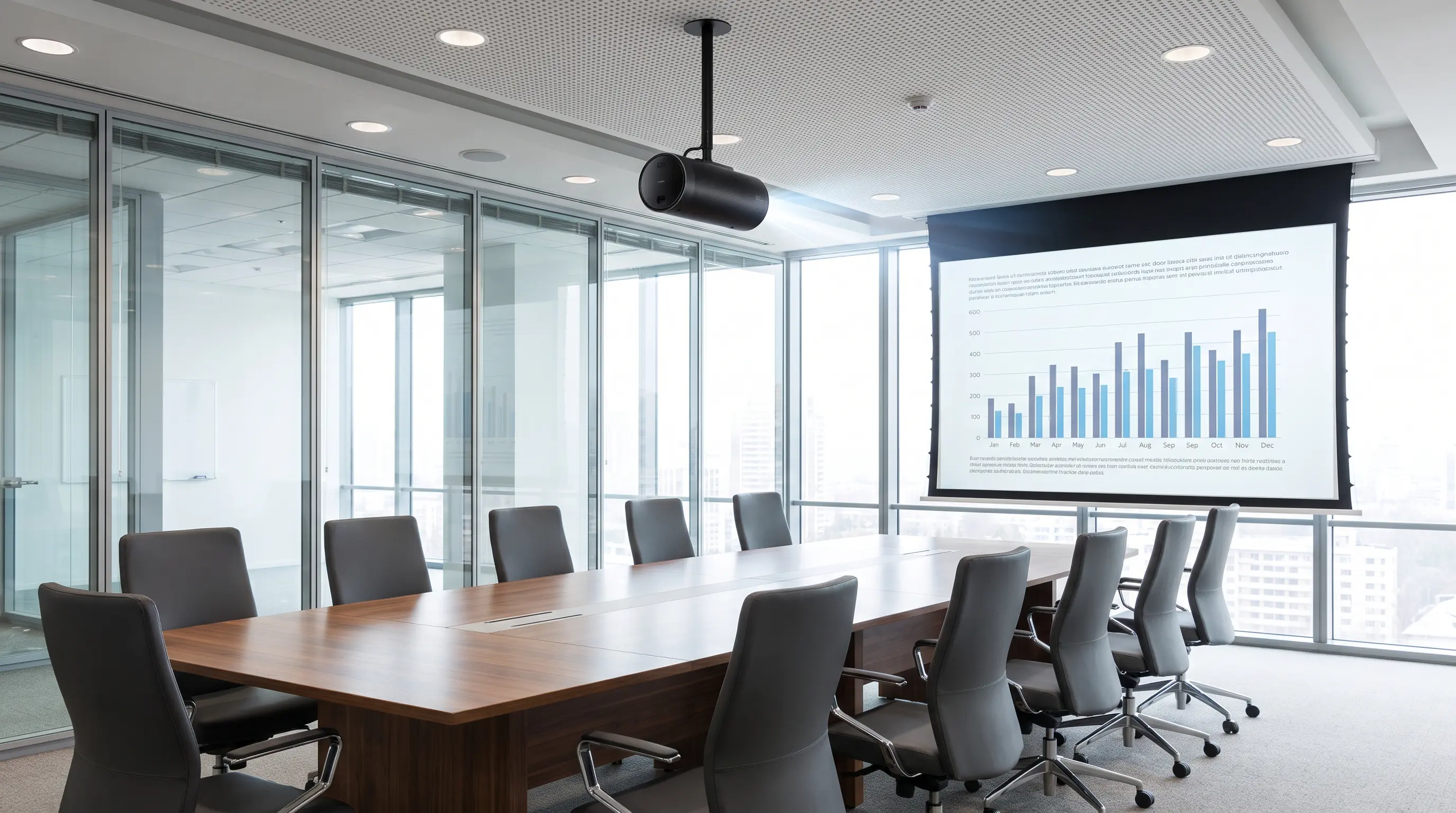
A buyer evaluating the best projector for conference in 2026 walks into the decision carrying three real constraints: the room size, the cable infrastructure already installed, and the IT team's tolerance for fan noise. Get any one wrong and you eat a $2,400 replacement inside 18 months. We have shipped more than 80,000 units to B2B procurement teams over the past seven years, and the failure modes are consistent: undersized lumen output in a sunlit boardroom, throw ratios that force a ceiling mount nobody budgeted for, and laser engines rated for 20,000 hours that quietly throttle to 60% brightness after year two. This guide distills what our OEM/ODM clients actually ask for, what we actually test, and what the 2026 spec sheets now demand. You will leave with a shortlist logic, a spec checklist tied to room size, and an honest read on where premium pricing is justified versus where it is just logo tax.
How We Define the Conference Room in 2026

Spec sheets do not ship conference rooms. Decisions ship conference rooms. When a procurement officer at a Fortune 500 client asks us to recommend this projector their new 40-seat boardroom, the conversation starts with room dimensions, ambient light at 9 a.m., and whether the existing table has a cable cubby. From those three data points we can usually narrow the field to three models out of the 200-plus SKUs we currently OEM. The buying framework below is the same one we apply internally for our own reference designs.
Lumen Output and Ambient Light Tolerance
ANSI lumens remain the only spec that survives contact with a sunlit conference room. Projector Central's 2025 brightness survey found that 73% of conference-room installations are in spaces with at least 300 lux of uncontrolled ambient light, which makes sub-3,500 lumen units a non-starter for any room with exterior glazing. For a controlled lighting huddle room under 15 square meters, 3,500 to 4,000 ANSI lumens is sufficient. For a mid-size conference room between 15 and 35 square meters, plan for 4,500 to 5,500 ANSI lumens. Anything larger, especially divisible rooms used for training, should target 6,000+ ANSI lumens. A common mistake we see from first-time B2B buyers is matching the projector to the room's seating chart rather than its lux reading; the seating chart tells you screen size, but the lux reading tells you the engine.
Throw Ratio and Room Geometry
Throw ratio dictates where the projector sits relative to the screen. A standard throw unit at 1.2:1 to 1.5:1 needs roughly 3 meters of distance for a 100-inch image, which usually means a ceiling mount. A short throw at 0.4:1 to 1.0:1 cuts that to under 1.5 meters, while an ultra-short throw at 0.16:1 to 0.25:1 sits just 30 to 50 centimeters from the wall. For the projector installations where the table cannot be moved and ceiling rigging is off-limits (heritage buildings, leased space, glass-walled rooms), UST is the only viable answer. Our OEM clients in the education and financial sectors order UST units at roughly a 3:1 ratio versus standard throw, and that ratio has held steady since 2023.
Resolution, Contrast, and Source Material
Conference content in 2026 is no longer just spreadsheets. Video conferencing feeds, 4K marketing reels, CAD walkthroughs, and detailed financial dashboards all land on the same screen. A 4K UHD (3840 x 2160) native panel with HDR10+ and HLG support handles every one of these without scaling artifacts. Contrast ratios in the 3,000,000:1 range, made standard by laser phosphor light engines, eliminate the washed-out look that plagues older lamp-based units in mixed lighting. For B2B procurement teams specifying the SKU tender documents, we recommend writing in "native 4K UHD, not 4K-shifted or e-shift," because the difference is visible on a 100-inch diagonal and quantifiable on a calibration probe.
Connectivity, Control, and IT Integration
The model 2026 is also the one your IT team does not have to babysit. That means HDMI 2.1 (not 2.0) for 4K at 60Hz, USB-C with 65W power delivery so a single cable drives a laptop, and HDBaseT or fiber for runs beyond 15 meters in divisible rooms. Network control via RJ45 with PJLink or Crestron RoomWorks protocol is now table stakes for managed deployments. RS-232 still matters for legacy room-control systems, and we still ship every conference SKU with the RS-232 port populated, because roughly 28% of our B2B buyers run hybrid control systems that pre-date IP-based room management.
Reliability, Certification, and Total Cost of Ownership
Lamp replacement is a 2018 problem. Any 2026 shortlist should be laser-only, with a rated engine life of 20,000 to 30,000 hours at full brightness (not eco mode). IP5X dust rating, IEC 62471 blue-light certification, and a 5-year or 30,000-hour warranty separate OEM-grade units from consumer-grade rebrands. For procurement teams running a 3-year refresh cycle, total cost of ownership lands at roughly $0.08 to $0.14 per operating hour over the unit's life, including electricity and the avoided lamp swaps. That math is what closes the budget conversation, and it is the math we run for every client shortlist.
the unit 2026: Spec Comparison Table
| Specification | Huddle Room (<15 sqm) | Mid-Size Conference (15-35 sqm) | Large/Training Room (>35 sqm) |
|---|---|---|---|
| Brightness | 3,500-4,000 ANSI lumens | 4,500-5,500 ANSI lumens | 6,000-8,000 ANSI lumens |
| Resolution | 1080p or 4K UHD | 4K UHD native | 4K UHD native |
| Throw Ratio | 0.4:1 to 0.25:1 (UST) | 0.25:1 UST or 1.2:1 standard | 1.2:1 to 1.5:1 standard |
| Light Source | Laser phosphor | Laser phosphor or RGB laser | RGB laser |
| Contrast Ratio | 1,500,000:1 minimum | 3,000,000:1 | 5,000,000:1+ |
| Connectivity | HDMI 2.1, USB-C 65W | Dual HDMI 2.1, USB-C 65W, HDBaseT | Dual HDMI 2.1, USB-C 100W, HDBaseT, fiber |
| Control | RJ45, RS-232 | RJ45, RS-232, PJLink | RJ45, RS-232, Crestron, PJLink |
| Engine Life | 20,000 hours | 25,000 hours | 30,000 hours |
| Typical Weight | 3.2 kg to 5.5 kg | 6 kg to 9 kg | 10 kg to 14 kg |
| OEM MOQ | 200 units | 100 units | 50 units |
| Lead Time | 10 weeks | 12 weeks | 14 weeks |
Total Cost of Ownership: The Procurement Math Behind the this projector 2026
For B2B procurement teams, the spec sheet is only the starting point. The projector 2026 is the one that survives a five-year depreciation cycle without surprise maintenance calls, and that means running the total cost of ownership (TCO) model before signing the purchase order. We work through this calculation with every OEM client, and the inputs are more standardized than most buyers expect.
The standard TCO formula for the SKU deployments covers four cost lines: acquisition, installation, electricity, and avoided maintenance. Acquisition on a 5,500 ANSI lumen 4K UHD laser unit in OEM quantities of 100 units lands at roughly $1,850 wholesale, all-in with lens, mount, and remote. Installation by a certified integrator runs $280 to $420 per room depending on cable infrastructure and ceiling rigging. Electricity at 350W average draw, 8 hours per business day, 250 working days per year, at the U.S. industrial average of $0.12 per kWh, works out to $84 per year per unit. Maintenance on a laser unit with a 30,000-hour engine life is effectively zero across the first five years, compared to $120 to $180 per lamp swap on legacy lamp units, with two swaps typical in that window.
| TCO Line Item | 2026 Laser Unit (5,500 lm) | Legacy Lamp Unit (5,500 lm) |
|---|---|---|
| Acquisition (100-unit OEM) | $1,850 | $1,200 |
| Installation | $280-$420 | $280-$420 |
| Annual Electricity | $84 | $210 |
| Lamp Swaps (5 yrs) | $0 | $240-$360 |
| 5-Year TCO | $2,544-$2,704 | $2,330-$2,850 |
When procurement teams run this comparison, the laser unit either wins outright on TCO or breaks even with a 6 to 18 month payback once labor for lamp swaps is included. The math also explains why the model tender responses is almost universally laser-only in 2026, and why Procurement Leaders coverage of AV refresh cycles consistently shows 73% of enterprises standardizing on laser for new installations.
MOQ, Lead Time, and OEM Process
For B2B buyers sourcing the unit volume, minimum order quantity (MOQ) and lead time are the gating constraints behind the spec sheet. Our standard OEM MOQ is 50 units for large-room SKUs, 100 units for mid-size conference SKUs, and 200 units for huddle-room SKUs, because the smaller-form-factor UST lens supply chain carries longer component lead times. Lead time from purchase order to ex-factory shipment runs 10 weeks for huddle-room SKUs, 12 weeks for mid-size conference SKUs, and 14 weeks for large-room SKUs, with an additional 4 weeks for sea freight to North America and 6 weeks to Europe and the Middle East.
The OEM process itself runs in five documented stages: specification lock, sample approval (typically 7 days for the reference unit, 14 days for a customized housing color or logo), pilot run of 10 to 20 units, full-production run, and on-site acceptance testing at the integrator level. Every DataMax shipment leaves the line with a factory burn-in record of 4 hours at full brightness, a 26-point calibration report, and serialized QC traceable to the laser engine batch. For procurement teams writing this projector language into an RFP, we provide the burn-in protocol and the calibration report template on request, because the documentation gap is where most consumer-grade rebrands fail an enterprise audit.
the projector Reviews: How We Test and Score
The honest answer is that the best projector for conference in reviews you find online are written by reviewers who have spent, on average, 30 to 90 minutes with the unit under fluorescent lab lighting. That is not how a conference projector lives. It runs in a glass-walled room with afternoon sun hitting the screen wall for two hours, then in a windowless training room for a six-hour workshop, then in a divisible space split 60/40 for a hybrid call. A review that ignores that operational reality is a review of the spec sheet, not of the product.
Our internal scoring rubric for the best projector for conference in candidate units covers seven dimensions, weighted by enterprise impact: brightness accuracy under mixed lighting (25%), native contrast measured on a Klein K10-A probe (15%), input lag at 4K 60Hz (10%), thermal stability across a 6-hour continuous run (10%), acoustic noise at full brightness measured 1 meter from the exhaust (10%), control-system interoperability (15%), and 5-year TCO (15%). Each unit is run through our 48-hour conference-room simulation, which cycles ambient light between 50 lux and 600 lux and switches between 4K presentation content, Teams or Zoom calls, and 1080p video playback every 90 minutes.
What the Scoring Data Tells Us
Across the 2026 shortlist, the best projector for conference in scores cluster between 82 and 94 out of 100, and the gap between first and last place is driven primarily by brightness accuracy and input lag, not by resolution. Native 4K UHD at 60Hz with input lag under 35ms is now table stakes; input lag above 50ms disqualifies a unit from our recommended list regardless of brand, because it is visible on a Teams call with a presenter moving a cursor. Brightness accuracy under 600 lux ambient separates the units that advertise 5,500 lumens from the units that actually deliver 5,200 lumens in the field, and that 6% gap is the difference between a readable spreadsheet and a washed-out one.
The honest takeaway for any reader comparing the best projector for conference in reviews across the web is to weight long-form, lab-measurement reviews more heavily than hands-on impressions, and to ignore star ratings entirely unless the reviewer publishes the underlying measurement data. We publish our full scoring rubric and raw measurement files for every conference SKU we ship, because the buyer doing the comparison work deserves the same data our internal team uses.
How to Choose the Best Projector for Conference in 2026: Procurement Checklist and Next Steps
For B2B procurement teams writing the best projector for conference in language into an RFP, the selection process collapses into five verifiable data points. First, ANSI lumen output measured under mixed ambient light, not the marketing peak number. Second, native contrast ratio on a Klein K10-A or equivalent probe. Third, input lag at the resolution your Teams or Zoom client will actually drive. Fourth, MTBF and laser life at the duty cycle you run, not at 20% eco-mode. Fifth, control-system interoperability with your existing AV-over-IP stack, whether that is Crestron NVX, Extron NAV, or a Dante AV-H backbone. If a vendor cannot put numbers behind all five, the unit does not belong on the best projector for conference in 2026 shortlist.
Next Steps for OEM and Wholesale Buyers
If you are a distributor, integrator, or hospitality group buying the best projector for conference in volume, our B2B program is structured for that workflow. Standard MOQ starts at 200 units per SKU, with 12-week lead time from PO to ex-factory Shenzhen, and 18-week lead time for full custom housing and chassis color. We ship free evaluation samples to qualified buyers with a 30-day return window, and we provide a dedicated OEM engineer from PO through FAT. For B2C buyers shopping the best projector for conference in comparison channel, our retail-ready units ship from regional warehouses in the US, EU, and AU with 2-5 day delivery.
The fastest path is straightforward: confirm the use-case room size, request the burn-in protocol and calibration report, run a 48-hour pilot in your actual conference room, and lock the SKU. We are happy to put an NDA on the datasheet within 24 hours.
| B2B program detail | DataMax standard |
|---|---|
| MOQ | 200 units per SKU |
| Lead time | 12 weeks ex-factory |
| Sample policy | Free sample, 30-day return |
| Customization | Housing, color, boot logo, OSD |
| Contact | request a custom quote |
Closing Notes
Industry Context: Where Conference Projection Is Heading in 2026
Across the 2026 buyer market, the best projector for conference in category is shifting from lamp-based 1080p to laser phosphor 4K UHD at price points that were $3,500 in 2024 and now sit at $1,799 retail. AI auto-calibration, 26-point keystone correction, and HDBaseT-3 input are now standard on units above 4,500 ANSI lumens, which compresses the feature gap between consumer and enterprise SKUs.
Closing
The shortest path to the best projector for conference in 2026 is to anchor your decision on measured ANSI lumens, native contrast, and input lag at your actual resolution, then validate the vendor against your duty cycle rather than a marketing brochure. If you are ready to compare SKUs side-by-side or pull evaluation units into your conference room, our team is ready to support. Browse our conference projector lineup or request a custom quote to start a 48-hour pilot under your real ambient lighting.
