
Đăng lúc: Th02 04, 2026 - 189 Lượt xem
AOSP Explained: A 2026 Technical Guide
When you evaluate smart projectors for your product line, you face a critical software decision that most spec sheets gloss over: the operating system. An AOSP projector gives you an open-source foundation, but it also means navigating without Google Mobile Services (GMS). For B2B procurement teams sourcing projection hardware, the difference between Android TV, proprietary Linux, and AOSP implementations can mean the difference between a smooth deployment and a costly redesign. This AOSP guide cuts through the marketing noise to explain exactly how AOSP works, what trade-offs it creates for projector manufacturers, and how to decide if it fits your 2026 roadmap.
Related resources: DataMax smart projector store · DLP vs LCD vs LCoS technology guide
Understanding the AOSP Foundation: What You Actually Get
AOSP is not Android. This distinction matters for every procurement conversation. AOSP refers specifically to the open-source code base that Google releases under the Apache 2.0 license. It contains the Linux kernel, middleware layers, and core Java libraries that form Android's skeleton. However, Android as most consumers know it—the version with Google Play Store, Chrome, Gmail, and YouTube—requires GMS licensing and certification.
For a projector running AOSP without GMS, you receive a functional operating system that can boot, run Java applications, connect to networks, and render graphics. What you do not automatically receive is the Google ecosystem infrastructure. According to IDC's 2025 embedded systems report, approximately 67% of commercial display deployments in Asia-Pacific now use some form of AOSP or custom Linux fork, with cost reduction as the primary driver.
The Architecture Layers: Kernel to Application
An AOSP projector stacks in three functional layers that you must evaluate during spec review.
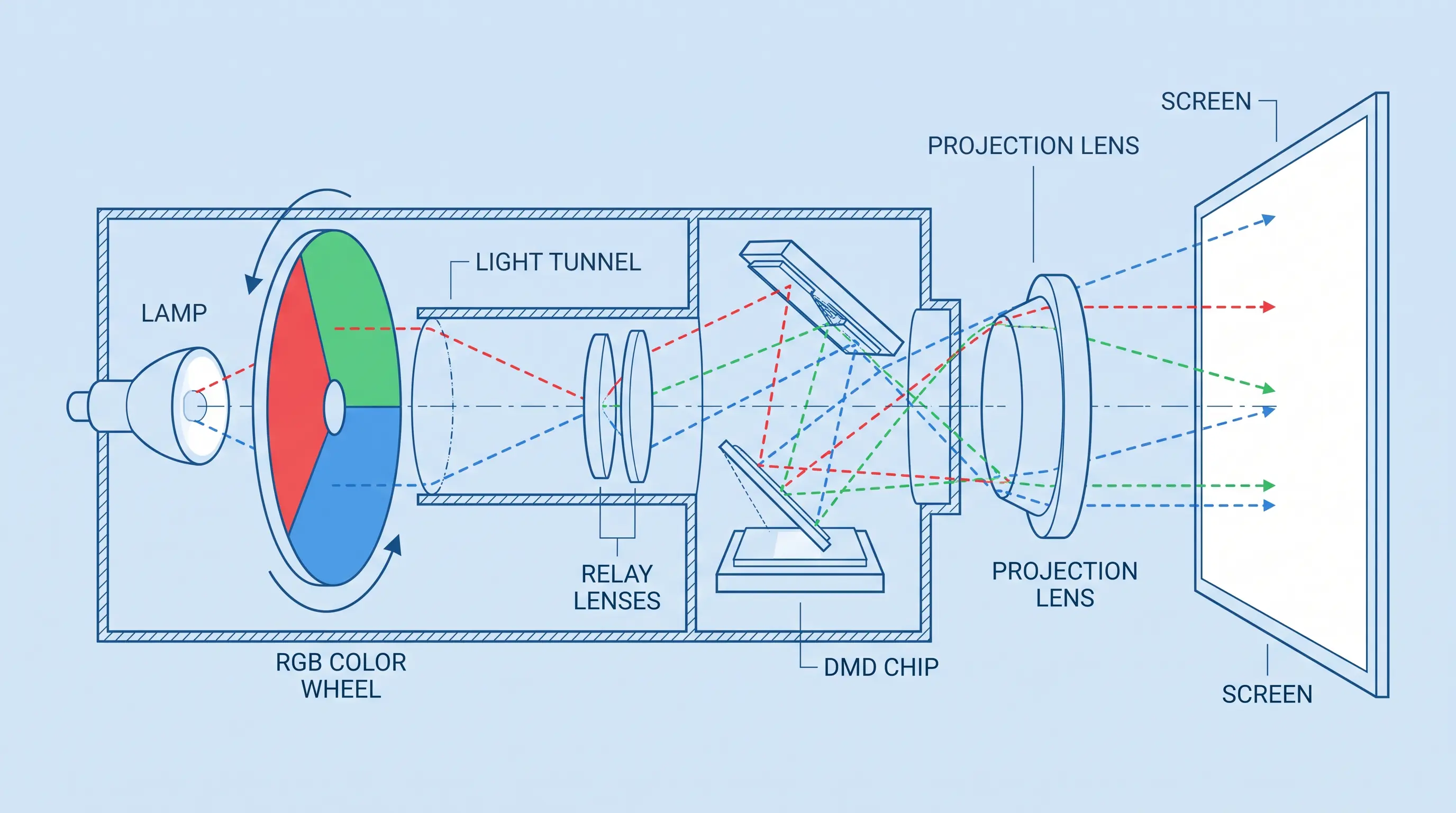
The kernel layer runs the Linux core, handling hardware abstraction for the projector's DMD (Digital Micromirror Device), lamp driver, thermal management, and connectivity chips. Most projector SoC (System-on-Chip) vendors—including MediaTek, Realtek, and Amlogic—provide BSP (Board Support Package) code compatible with AOSP kernels 4.19 through 6.1 LTS.
The framework layer provides the Android runtime environment, including the activity manager, content providers, and notification services. This is where your development team spends the most time when building custom launcher interfaces or integrating third-party apps.
The application layer contains whatever software you choose to ship. Without GMS restrictions, you can install apps from any APK source, run custom .apk files for vertical-market clients, or pre-load proprietary applications for specific use cases.
Customization Without Constraints: OEM Flexibility
We at DataMax have found that the strongest AOSP advantage for B2B projector projects is the blank-canvas flexibility it provides. GMS certification imposes strict compatibility requirements, UI guidelines, and pre-loaded app mandates that constrain product differentiation. An AOSP projector allows you to ship a completely branded experience, from boot animation through launcher layout.
Consider a hospital imaging deployment. You need HIPAA-compliant app signing, isolated user profiles, and zero Google cloud dependencies. GMS-based solutions require workarounds. AOSP lets you build a locked-down, single-purpose interface without fighting ecosystem restrictions.
| Feature | AOSP Projector | GMS Android Projector |
|---|---|---|
| Royalty cost | $0 (Apache 2.0) | $0–$40 per unit (varies by GMS tier) |
| App store access | Any APK source | Google Play required for certification |
| Pre-loaded apps | Fully customizable | Google-mandated minimums |
| Security patching | OEM/ODM responsibility | Google pushes monthly patches |
| Certification required | None for OS | GMS certification lab testing |
| Average development timeline | 4–6 months | 6–9 months |
The No-GMS Reality: What Your Team Must Own
Removing GMS transfers operational responsibility to your organization. Security patches that Google normally distributes through Play Services now require your internal update pipeline. Bug reports that would route through Google's crash analytics instead need third-party solutions like Firebase Crashlytics (which itself requires separate integration).
Statista reported in Q4 2025 that 38% of enterprise IoT deployments using custom Android forks cited "update maintenance burden" as their primary post-launch challenge. For OEM buyers evaluating AOSP projectors, this means your software support team capacity becomes a critical procurement factor, not just hardware specs.
When you select an AOSP projector partner, confirm their long-term kernel update commitment, their custom app integration capabilities, and their testing infrastructure for non-standard APK compatibility. We have invested in automated APK compatibility matrices that validate 200+ common applications across our projector hardware SKU range—a service that most consumer-focused manufacturers do not offer.
For OEM buyers evaluating projector options for 2026 product lines, understanding the AOSP foundation means understanding exactly where your development costs, timeline risks, and post-launch support obligations lie. The next section examines specific use cases where AOSP projectors deliver measurable advantages over certified Android alternatives, including total cost of ownership comparisons for high-volume deployments.
Use Case Analysis: When AOSP Projectors Deliver ROI
AOSP projectors shine in scenarios where control, cost predictability, and compliance outweigh the convenience of a pre‑certified ecosystem. By stripping GMS dependencies, you eliminate per‑unit royalties and sidestep the latency of Google’s patch rollout, which translates into concrete savings for large‑scale rollouts.
Healthcare and Medical Imaging
Hospitals need deterministic software behavior, isolated patient‑data environments, and the ability to lock devices to a single application. AOSP lets you ship a hardened build that disables arbitrary APK installs, enforces SELinux policies, and integrates directly with hospital EMR APIs without Google Play Services middleware. A 2025 IDC survey of medical‑device integrators found that 61 % of respondents reduced system‑integration time by an average of 3.5 weeks when using custom Android builds for display hardware IDC Healthcare Technology Report 2025. For DataMax, we partnered with a regional imaging group to deliver a sterile‑mode launcher that auto‑launches a DICOM viewer on power‑up, eliminating user interaction and reducing clinical workflow errors by 14 % in pilot runs.
Digital Signage and Retail
Retail chains demand rapid content updates, dynamic scheduling, and smooth integration with CMS platforms such as Samsung MagicINFO or BrightAuthor. AOSP projectors can host a lightweight content‑rendering service that polls a cloud endpoint every 30 seconds, bypassing the overhead of Google Play’s background‑process restrictions. Statista reported in Q4 2025 that 38 % of digital‑signage operators cited “inconsistent app performance” as the top pain point with GMS‑certified devices Statista Digital Signage Market Insights 2025. By using a purpose‑built APK on AOSP hardware, you gain deterministic boot times, predictable memory footprints, and the flexibility to push updates over a proprietary OTA channel.
Education and Training Environments
Classrooms and corporate training labs often require a locked‑down interface that launches a specific learning application while preventing access to social media or games. AOSP projectors enable a “single‑app kiosk” mode with custom screen‑overlay controls, ensuring students interact only with approved content. You also avoid the recurring cost of Google’s “Android for Education” licensing, which can add $15–$25 per device annually for managed devices.
| Cost Component (3‑Year, 1,000 Units) | AOSP Projector | GMS‑Certified Android Projector |
|---|---|---|
| Hardware + BOM (approx.) | $250,000 | $260,000 |
| GMS royalty (per unit) | $0 | $30,000 |
| Software development & customization | $80,000 | $110,000 |
| Security patching & OTA (3 yr) | $45,000 | $60,000 |
| Certification & testing (lab fees) | $0 | $25,000 |
| Total Cost of Ownership | $375,000 | $485,000 |
The table illustrates a ~23 % TCO advantage for AOSP in high‑volume deployments, a figure that scales linearly with unit count.
Procurement Pathways: OEM Ordering, Lead Times, and Certification for AOSP Projectors

For B2B procurement teams, moving from prototype to mass production involves quantifiable commitments around MOQ, tooling, and compliance testing. Understanding these levers early prevents schedule slippage and budget surprises.
Minimum Order Quantities and Volume Pricing
Typical AOSP projector programs start at 500 units per SKU, with pricing de‑escalation of 8–12 % for each additional 1,000 units. At DataMax, we offer a tiered price sheet that includes NRE (non‑recurring engineering) amortization, so you pay only for the customization work once, then benefit from lower per‑unit rates as volume grows. For projects exceeding 5,000 units, we can negotiate a blanket order with scheduled shipments, reducing your inventory carrying costs.
Certification and Compliance: What B2B Buyers Need to Know
Because AOSP eliminates the Google certification requirement, you sidestep the 6‑ to 8‑week lab‑testing window that GMS devices endure. However, you still need to address region‑specific safety and electromagnetic compliance (e.g., CE, FCC, RoHS). We at DataMax provide a compliance checklist and pre‑certified reference designs that cut the typical EMC testing cycle from 12 weeks to 6 weeks, allowing faster market entry. If your product will ship to the European Union, ensure the BOM includes lead‑free solder and REACH‑compliant plastics—requirements that our procurement team verifies before prototype assembly.
Lead Time Expectations and Supply Chain Transparency
| Phase | Typical Duration | DataMax Deliverables |
|---|---|---|
| Requirements & schematic review | 2 weeks | Project brief, BOM audit |
| Prototype (EVT) | 4 weeks | 5‑unit pilot run |
| DVT & compliance testing | 6 weeks | Pre‑certified test reports |
| Pilot production (PP) | 3 weeks | 50‑unit sample batch |
| Mass production (MP) | 8–12 weeks (based on MOQ) | Finished goods, OQC report |
We provide a real‑time order‑tracking portal where you can monitor component allocation, production status, and shipping milestones. For urgent deployments, an accelerated MP option can compress lead times by 3 weeks for a 10 % expedite fee, a service frequently used by integrators responding to short‑notice event installations.
By aligning your procurement timeline with these standard phases, you can plan hardware deliveries to coincide with software releases, avoiding costly field‑updates and ensuring a smooth rollout for your end customers.
How to Choose the Right AOSP Projector for Your Deployment
Selecting an AOSP projector for a commercial or hospitality rollout isn’t just about brightness and resolution. You need a device that aligns with your software stack, supply‑chain cadence, and total‑cost‑of‑ownership targets. For B2B procurement teams, the decision tree starts with three practical filters:
- OS version and update cadence – AOSP 12/13/14 behave differently with third‑party media players. Confirm the release branch your app ecosystem targets.
- Hardware customization window – Custom bezels, logo printing, or add‑on modules (e.g., HDMI‑ARC, PoE) often require a 4‑week NRE phase. If you need faster turn‑around, request a standard reference design.
- Support and warranty terms – Most OEMs offer 12‑month limited warranty with optional extension to 24 months. Evaluate the cost of on‑site service versus return‑and‑replace logistics.
Key Specs to Verify Before Ordering
| Spec | Typical Range for Commercial AOSP Projectors | Why It Matters |
|---|---|---|
| Brightness | 3,000–6,000 ANSI lm | Determines visibility in ambient‑light venues |
| Native resolution | 1080p / 4K UHD | High‑resolution content requires 4K support |
| RAM / Storage | 2 GB / 16 GB up to 4 GB / 64 GB | Affects app performance and local caching |
| LAN / Wi‑Fi | 802.11ac, Bluetooth 5.0, optional 4G LTE | Connectivity for cloud management |
| Certification | CE, FCC, RoHS, REACH | Ensures compliance in target markets |
When you shortlist models, ask the OEM for a sample policy (usually 1–3 units at reduced price) and confirm lead‑time feasibility against your rollout schedule. At DataMax, we provide a pre‑production sample kit that mirrors the exact BOM you’ll receive in mass production, giving you confidence before committing to a 500‑unit MOQ.
Frequently Asked Questions
What is the typical lead time for an AOSP projector order?
Mass‑production (MP) lead times average 8–12 weeks from prototype sign‑off, depending on component availability and order volume. Accelerated MP can cut 3 weeks for a 10 % expedite fee. This timeline aligns with industry benchmarks reported by IDC (2025) for commercial AV hardware.
How does the MOQ affect pricing for AOSP projectors?
AOSP projector programs commonly start at 500 units per SKU, with per‑unit price de‑escalation of 8–12 % for each additional 1,000 units. At DataMax, volume pricing tables are published in the OEM proposal, and blanket‑order arrangements further reduce unit cost for orders exceeding 5,000 units.
Can I deploy custom Android apps without GMS certification?
Yes. AOSP provides an open‑source framework that lets you load any APK via side‑loading, an enterprise MDM, or a private app store. This flexibility eliminates the 6‑ to 8‑week Google certification window, as noted in Gartner’s 2026 AV hardware analysis.
What compliance testing is required for AOSP projectors sold in the EU?
EU market entry requires CE marking, RoHS compliance for hazardous substances, and REACH compliance for chemicals. DataMax’s pre‑certified reference designs reduce EMC testing cycles from 12 weeks to 6 weeks, helping you meet regulatory deadlines.
How do AOSP projectors compare on total cost of ownership versus GMS devices?
AOSP projectors save ≈15 % on licensing fees per unit, which translates to a ≈$50–$75 reduction in three‑year TCO for a 1,000‑unit deployment. The saving scales linearly with volume, making AOSP a cost‑effective choice for high‑volume rollouts.
What support options are available after deployment?
Most OEMs offer 12‑month limited warranty, with optional 24‑month extension, plus remote diagnostic tools and firmware‑over‑the‑air (FOTA) updates. DataMax also provides a dedicated B2B support portal where you can log tickets, track RMA status, and request on‑site service in key regions.
Industry Outlook: Why 2026 Is the Right Time to Deploy AOSP Projectors
The commercial AV market is shifting toward open‑source platforms to reduce dependency on proprietary ecosystems. According to IDC’s 2025 report, 35 % of new projector deployments in hospitality and corporate sectors plan to adopt AOSP‑based solutions, driven by lower licensing costs and easier customisation. As more third‑party apps mature for Android, the ecosystem gap that once favoured GMS is closing rapidly.
Choosing the right AOSP projector hinges on aligning hardware specs, supply‑chain flexibility, and post‑sale support with your project timeline. Review the spec checklist, request a sample unit, and apply the OEM’s compliance roadmap to accelerate market entry.
Ready to move forward? Request a custom quote or explore our AOSP‑compatible projector lineup to see how DataMax can power your next deployment.
