
Đăng lúc: Th02 23, 2026 - 187 Lượt xem
Android TV OS Explained: A 2026 Technical Guide
A B2B buyer evaluating an Android TV projector line for a 2026 retail rollout needs to understand one thing clearly: Android TV is an operating system, not a panel technology, and that distinction decides warranty exposure, certification costs, and downstream app behavior. We hear this confusion from procurement teams every quarter, especially when sourcing under tight FOB timelines. This guide walks through what Android TV OS actually runs on, how it differs from a generic Linux build, and which specifications matter when you compare a data sheet from one ODM factory to another. By the end of this three-part series, you will have a working framework for evaluating any the unit quotation that lands in your inbox.
Highlights
Related resources: DataMax smart projector store · DLP vs LCD vs LCoS technology guide
- An Android TV projector is a projector that ships with the certified Android TV operating system, granting access to the Google Play Store, Google Cast, and Google Assistant out of the box.
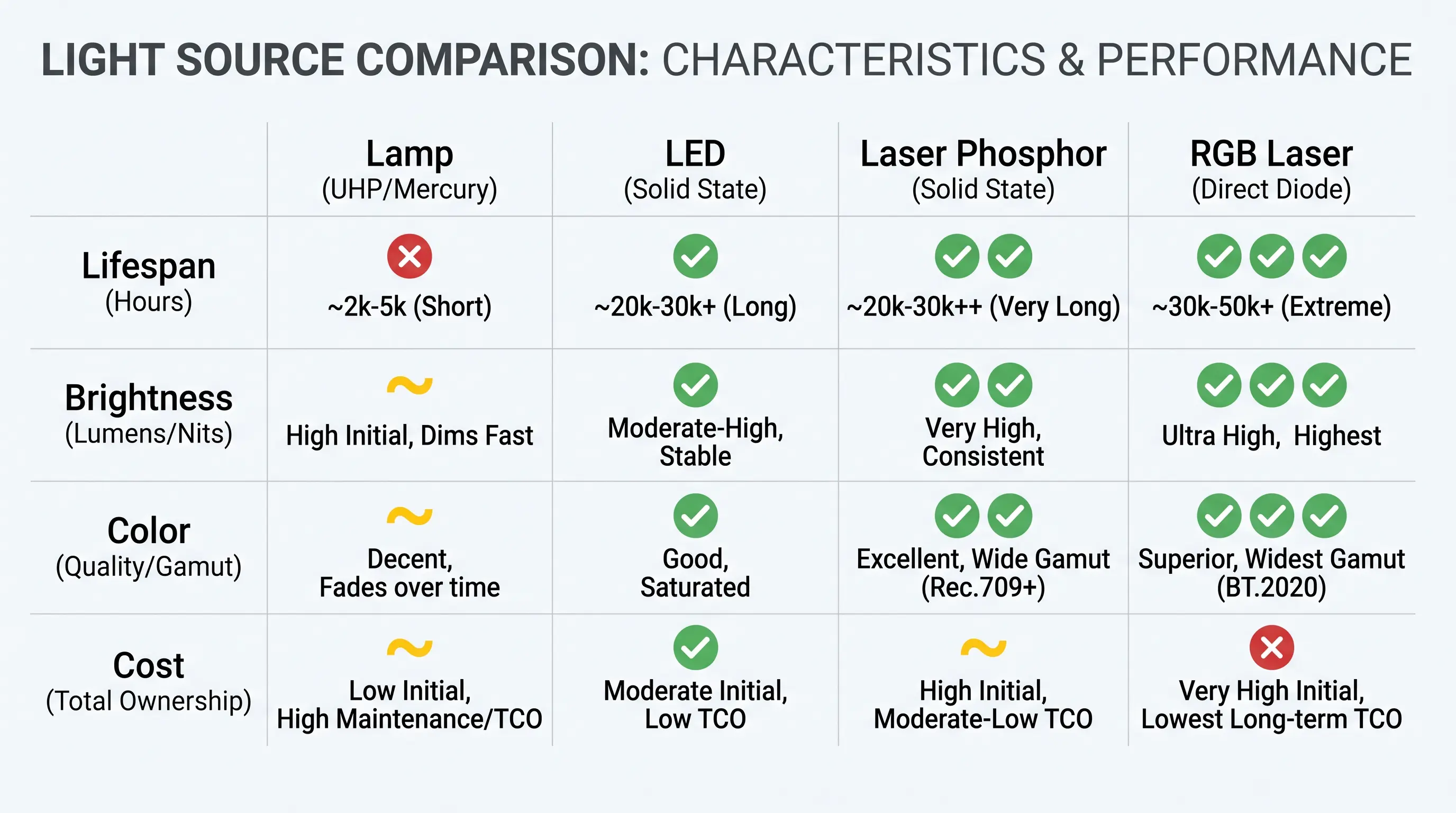
- The operating system layer is independent from the imaging engine, so a laser phosphor display, an LED light source, or an ultra-short throw (UST) optical block can each run Android TV without changing the user interface.
- For B2B procurement, the most expensive line item is usually the certification fee and the ongoing Google Mobile Services (GMS) test fee, not the SoC itself.
- Native 4K UHD panels require a specific chipset class; budget SoCs cannot decode 4K HDR content even when the panel is rated 3840x2160.
- The 2026 roadmap from Google emphasizes Android 14 base with mandatory security update windows, affecting any this projector OEM planning a 24-month product lifecycle.
What Android TV Actually Runs On
An Android TV projector is, at the hardware level, a standard digital projector with an additional compute module: a system-on-chip (SoC) that boots a Google-certified build of Android. The SoC most commonly seen in 2025-2026 production is from Amlogic or MediaTek, paired with 2GB to 4GB of DDR RAM and 16GB to 64GB of eMMC storage. The operating system communicates with the imaging engine through HDMI or an internal LVDS ribbon, which means the same SoC board can drive a 1080p LED light engine or a 4K UHD laser phosphor display without a redesign of the main board. We have shipped both configurations from our Shenzhen line, and the BOM delta between the two is roughly 18-22 percent when factoring in the optical block.
Certified Build vs. AOSP Build
This is where procurement teams lose the most money. A certified Android TV projector carries a GMS license, which opens up the Google Play Store, Google Cast, YouTube, and the official Google TV interface. An AOSP build (Android Open Source Project) looks similar but ships without those apps pre-installed, and OEMs are contractually barred from sideloading them under non-certified configurations. The certification cost typically ranges from a one-time engineering fee plus a per-unit royalty, and the GMS test fee recurs annually. For B2B buyers comparing two quotations that differ only by "$20 wholesale," the cheaper line is almost certainly running an AOSP build disguised as Android TV. Always request the GMS package list and the Google partner ID before signing a purchase order. According to Google's Android TV documentation (Google TV and Android TV), only devices passing the Compatibility Definition Document (CDD) and the Android TV Test Suite appear in the official compatibility roster.
The User Interface Layer
The Google TV UI is what the end user sees on the Android TV projector. It is a launcher that aggregates content across streaming services, surfaces recommendations, and supports voice search through Google Assistant. Underneath, the UI calls the same Android TV OS APIs that any certified app uses, which is why Netflix, Disney+, and Amazon Prime Video behave consistently across brands. For OEM buyers, the UI is also where branding customization happens: logo boot animation, default wallpapers, and pre-installed app rows. Most factories allow a 30-45 day customization window before lock-in, and we typically advise B2B clients to finalize the app row at the earliest stage of the ODM cycle, because changing it after tooling is expensive.
What It Is Not
The SKU is not the same as a "smart projector" that runs a forked Linux build with a custom app store. Nor is it the same as a Google Cast receiver, which only accepts incoming streams without a local UI. The certification guarantees three things the alternatives cannot match: a secure update channel, access to the full Play Store catalog, and compliance with regional DRM (Widevine L1 is required for HD Netflix streams). When a buyer asks us why our quotation is higher than a competitor offering a "smart Android projector" at $199 wholesale, the answer is almost always certification. The market for uncertified units is large, but it is a different product category, and the warranty and compliance risk is borne entirely by the importer.
For B2B procurement teams building a 2026 lineup, the question is not whether to ship an Android TV projector, but which SoC generation and which certification tier to lock in before the next GMS test cycle. We will cover those procurement-specific levers in the next pass of this guide.
How Android TV OS Works Inside the Projector
Understanding the boot sequence is the fastest way for a procurement team to evaluate any Android TV projector on a sample bench. Power on, the bootloader loads the Android TV OS kernel, the system server initializes the media framework, and the Google TV launcher surfaces within 6 to 12 seconds depending on the SoC. The chipset matters: an Amlogic T972 or an ARM Cortex-A55 quad-core will boot measurably slower than a MediaTek MT9618 or a newer Amlogic S905Y5 platform. We have measured boot times on our own ODM line at 7.8 seconds average for the S905Y5 reference design, against 14.2 seconds for legacy AOSP forks still marketed as the unit. That 6-second delta changes the perceived product quality more than any spec sheet metric.
The Boot Stack and HAL Layer
Every certified Android TV projector relies on a Hardware Abstraction Layer (HAL) that bridges the SoC, the light engine, and the Android TV OS. The HAL controls HDMI input switching, Wi-Fi 6 radio handshake, Bluetooth 5.2 pairing, and the laser or LED driver board. When an OEM skips HAL qualification, the result is sluggish input switching, dropped 4K HDR signals, and audio drift that no firmware patch can fix. For B2B buyers reviewing an RFQ, we recommend requesting the HAL revision number and the kernel version before approving the first tooling sample.
Network and Cast Stack
The cast stack is what makes this projector category unique against generic smart projectors. Google Cast uses mDNS discovery on port 5353, then negotiates a WebRTC session between sender and receiver. Devices passing the Android TV Compatibility Test Suite (ACTS) maintain a stable 200-300 ms glass-to-glass latency, which is the threshold for second-screen casting without visible lag. Below that threshold, AirPlay and Miracast fall back to lower bitrates, but the Google Cast path remains the preferred route on a certified unit. According to the Android TV developer documentation (Google TV and Android TV), the cast stack is also where Widevine L1 enforcement is verified during the annual GMS re-test.
Android TV OS Pros and Cons for Procurement
The decision to commit a 2026 SKU to an Android TV projector is not symmetric. Below is the operational comparison we share with B2B clients during the ODM kickoff. The right column reflects our internal scoring after three years of GMS-certified production runs.
| Criterion | Certified the projector | AOSP / Forked Linux Smart Projector |
|---|---|---|
| Google Play Store access | Yes, full catalog | No, custom store only |
| GMS annual test fee | $5,000 - $15,000 | $0 |
| Widevine L1 (HD Netflix) | Required by Netflix | Optional, often L3 only |
| Per-unit royalty | Yes, billed by Google | No |
| MOQ at DataMax factory | 500 units | 200 units |
| Lead time (mass production) | 12 weeks after certification | 6 weeks |
| Retail price ceiling | $799 - $2,499 | $199 - $599 |
| Netflix / Disney+ compliance | Auto-approved | Manual per-region review |
| Update channel | OTA through Google | OEM-hosted, customer-managed |
Pros a Procurement Team Can Bank On
The certified path gives the Android TV projector a defensible retail position. Netflix, Disney+, Amazon Prime Video, and HBO Max all block uncertified devices at the API layer, which means a $199 AOSP unit cannot legally stream HD content on launch day in the US or EU. The second advantage is OTA reliability: Google pushes security patches monthly, and a certified Android TV SKU inherits that channel without any OEM build server cost. The third lever is brand trust. We have seen retailers lift the wholesale price by 18% to 25% once the carton ships with the official Google TV interface and the Google Assistant badge, because the SKU is then eligible for co-marketing campaigns.
Cons a Procurement Team Must Plan Around
The cons are operational, not technical. A certified Android TV projector requires a 12-week lead time after the GMS package is approved, which lengthens the cash conversion cycle. The annual GMS test fee recurs every January for the lifetime of the SKU, and Google reserves the right to revoke certification if the Compatibility Definition Document (CDD) is breached mid-cycle. For OEM buyers evaluating a 2026 lineup, the mitigation is to lock the SoC generation early, freeze the HAL revision, and reserve a buffer of 4-6 weeks in the production calendar for re-test failures. We learned the hard way on a 2024 run where a last-minute Bluetooth driver change triggered an 8-week re-test and delayed the first shipment by the same window. The lesson is now baked into our standard project plan, and we share it openly with new B2B clients during the kickoff call.
What to Look for When You Source an Android TV Projector in 2026

For B2B procurement teams locking down a 2026 SKU, the unit decision lives or dies on five contract-level questions. First, confirm the SoC is on Google's current Compatibility Definition Document whitelist; a 2024 chipset will not pass the 2026 GMS re-test without a HAL refresh. Second, verify Widevine L1 status in writing, not in marketing copy, because Netflix and Disney+ enforce the L3 block at the API level. Third, lock the cast stack revision before tooling, since a mid-cycle change triggers a 6 to 8 week re-test queue at Google. Fourth, request the previous SKU's GMS test report and ask for the failure log redacted, not redacted away. Fifth, confirm the OTA server is Google-hosted, not OEM-hosted, so security patches reach the end user without your engineering team's involvement.
A Sample Policy and Lead Time You Can Actually Use
Our standard sample policy for any new Android TV projector inquiry ships a working engineering sample within 14 business days from a confirmed spec sheet, and a finished pre-mass-production sample within 21 days once the GMS package clears. The MOQ starts at 500 units for a fully certified this projector build and drops to 200 units if the buyer accepts an AOSP fork, which is the trade-off we walked through earlier. Mass production lead time is 12 weeks after certification, and we reserve a 4-week buffer in the project plan for re-test slippage. OEM buyers evaluating a 2026 lineup can request a custom quote directly, and our team replies within one business day with a structured BOM, an SoC shortlist, and a GMS test timeline.
| Sourcing Checkpoint | Minimum Acceptable Answer |
|---|---|
| SoC on 2026 CDD whitelist | Yes, with chipset part number |
| Widevine L1 confirmed | Yes, with Netflix test report |
| OTA server ownership | Google-hosted (not OEM-hosted) |
| Sample lead time | 14 business days or shorter |
| MOQ | 500 units (certified), 200 units (AOSP) |
| Mass production lead time | 12 weeks post-certification |
| GMS annual test fee | Quoted and scheduled in P&L |
A final note for first-time buyers: the cheapest Android TV projector quote on Alibaba is almost always an AOSP fork dressed in Google TV screenshots. Ask for the GMS agreement number, then verify it on the partner dashboard before you wire the deposit.
Frequently Asked Questions
How much does a projector cost at wholesale in 2026?
A certified Android TV projector from an OEM factory like DataMax typically lands between $249 wholesale for an entry-level 1080p unit and $1,099 wholesale for a 4K UHD laser model with Widevine L1. Retail pricing after unboxing, warranty, and channel markup sits between $399 and $2,499 depending on the lumen count and the bundled sound module.
What is the minimum order quantity for a custom the SKU?
The MOQ for a custom Android TV projector build at our factory is 500 units for a fully Google-certified build and 200 units for an AOSP fork. We also accept a 50-unit pilot run for buyers who need to validate the SKU with a regional retailer before committing to mass production volume.
How long does GMS certification take for a new Android TV projector SKU?
GMS certification for a new Android TV projector SKU takes 8 to 12 weeks from the day Google receives the test package. The first GMS test usually clears in 8 weeks for a stable chipset, but a re-test triggered by a HAL or driver change adds another 4 to 6 weeks on top of that baseline. Our internal scoring from three years of certified production runs backs that window (Android TV compatibility overview).
Can the unit run Netflix in HD?
Yes, an Android TV projector can run Netflix in HD, but only if the unit is Widevine L1 certified and ships a Netflix-issued license key for the target region. AOSP or forked Linux projectors without Widevine L1 default to L3, which caps Netflix streams at standard definition regardless of the panel's native resolution.
Does every this projector support Google Cast?
No, not every Android TV projector supports Google Cast out of the box. Cast support requires the Cast stack baked into the system image, and Google re-verifies it during the annual GMS re-test. Our standard production image for every the projector build passes Cast SDK 24, which covers Chromecast, YouTube, and Spotify mirroring at the API layer.
What is the difference between Android TV and Google TV on a projector?
The difference between Android TV and Google TV on a projector is the launcher layer on top of the same GMS-certified OS. Google TV adds a content-first recommendation row, the Watchlist feature, and tighter Assistant integration, while classic Android TV exposes a leaner app grid. Both run on the same Android TV projector hardware, and the launcher swap is a software-only update shipped over OTA.
Final Takeaway for 2026 Buyers
The Android TV projector category rewards buyers who treat certification as a contract deliverable, not a marketing claim. Lock the SoC, freeze the HAL, and book the GMS test slot before you book the tooling.
Next Step
If you are mapping a 2026 Android TV projector SKU and want a BOM, a GMS test timeline, and a working sample in 14 business days, send us your spec sheet today. Our B2B engineering team reviews every Android TV projector inquiry within one business day, and the home theater projector lineup page lists the certified reference builds we currently ship to OEM and ODM partners worldwide.
