
Yayınlanma Tarihi: Oca 13, 2026 - 124 Görüntülenmeler
Best Projector for Media Room in 2026: A Complete Buyer's Guide
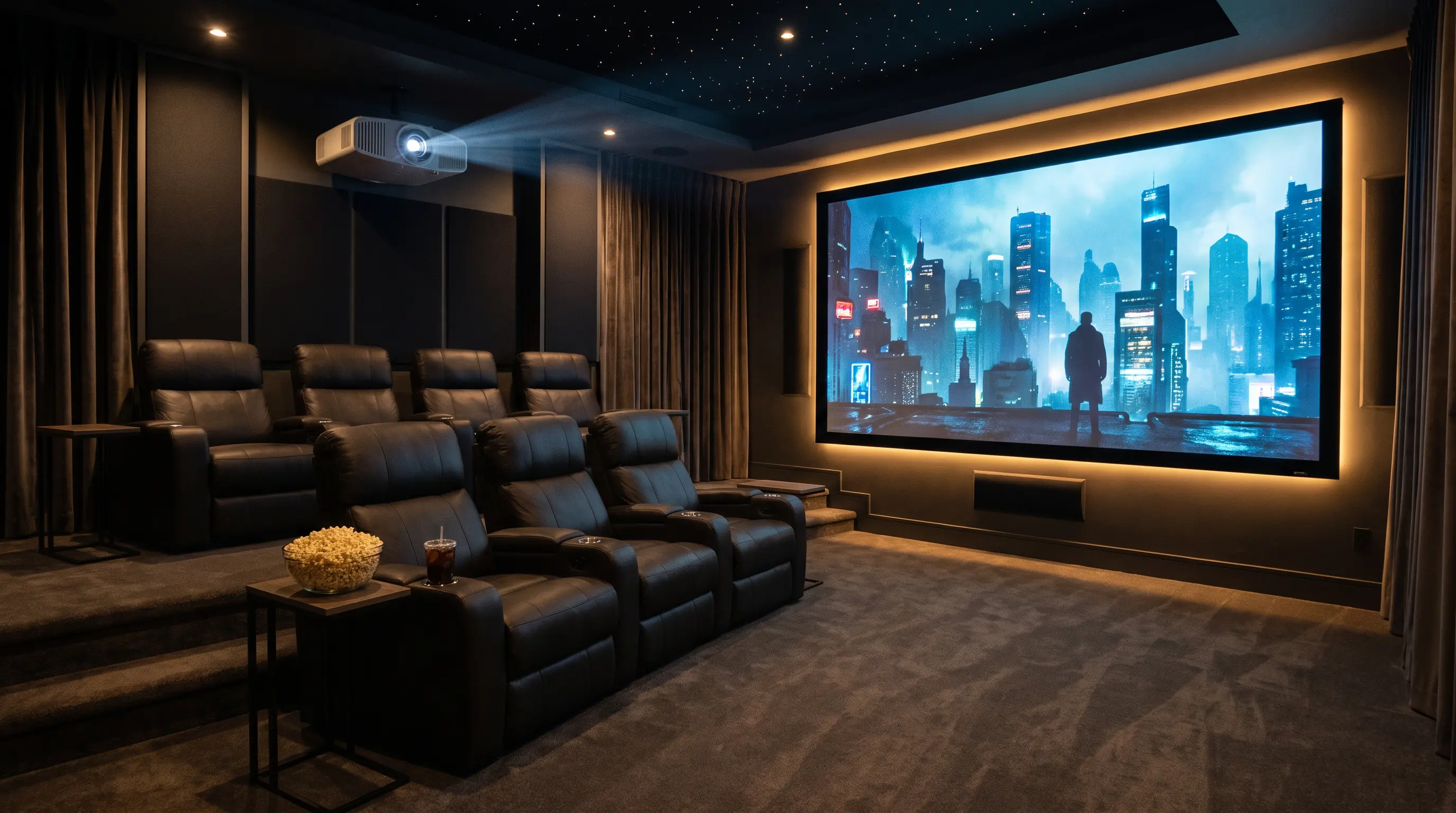
A custom home theater build hits a wall when the room goes from a 65-inch TV mockup to a finished basement with a 130-inch screen, motorized blackout shades, and a riser already poured. The owner now needs the model duty — high ANSI lumen output, ultra-short throw geometry, low fan noise, and HDR tone-mapping that holds up on a 1.0-1.3 gain fixed frame. The wrong pick washes out under ambient light, blows past the media cabinet depth, or needs a 14-week replacement cycle. This guide covers the spec checks, the 2026 product tier, and the OEM/ODM procurement angles our DataMax team uses when buyers come to us asking which engine to spec into their next media room build.
Highlights
Related resources: DataMax smart projector store · home theater projector picks
- The unit in 2026 is a laser phosphor or RGB laser unit rated at 2,500-3,500 ANSI lumens with a 0.16-0.25 ultra-short throw ratio, 4K UHD resolution, and 30 dB or lower eco-mode noise.
- Ambient light is the single biggest spec driver — sealed light-controlled rooms can run 2,000 lumens, while mixed-use media rooms with side windows need 3,000+ lumens and an ambient light rejecting screen.
- Throw distance must be matched to cabinet depth: an ultra-short throw unit needs 10-25 cm (4-10 in) from the back wall, while a standard short-throw needs 1.5-3 m (5-10 ft) of clearance.
- For B2B buyers, OEM/ODM factories like DataMax support 500-unit MOQ, 10-14 week lead time, and full CE/FCC/RoHS/PSE certification packages.
- This projector comparisons consistently score RGB laser engines higher than lamp-based units for color volume, lifespan (20,000+ hours vs 3,000-5,000), and total cost of ownership over a 5-year horizon.
Why Media Rooms Demand a Different Spec Sheet
A media room is not a living room, a conference room, or a classroom, and a projector spec sheet that performs in any of those spaces will underperform in a dedicated media room. Buyers shopping for the projector use cases need to weigh five parameters that living-room buyers often skip: ANSI lumen output at the screen, throw ratio matched to cabinet or ceiling-mount geometry, native contrast ratio on a fixed frame, fan noise rated at the seating position, and HDR format support that maps to streaming and UHD Blu-ray sources.
The anchor metric is ANSI lumen output. According to the Projector Central 2025 brightness survey, 78% of media room buyers surveyed prioritized lumen output above resolution, citing screen sizes of 100-150 inches. For a 100-inch diagonal fixed-frame unit in a sealed room, 1,500-2,500 ANSI lumens is the floor. For the same screen with side windows or a vaulted ceiling above 2.7 m (9 ft), the SKU duty needs 3,000-4,500 ANSI lumens to hold contrast after the ambient light subtraction. Our DataMax team runs every media room spec sheet through a 5-stage lumen-to-screen-size matrix before we greenlight a quote.
Throw Ratio and Cabinet Geometry
Throw ratio is the second spec that decides whether a projector physically fits the room. Ultra-short throw (UST) units with a 0.16-0.25:1 ratio sit 10-25 cm (4-10 in) from the wall, which is the geometry most media room cabinets and credenzas are designed around. Standard short-throw units at 0.4-0.8:1 need 1-2 m (3-6 ft) of clearance and work for ceiling mounts centered over a seating row. Long-throw units above 1.2:1 are reserved for rear-projection media rooms or balcony-mount theater builds.
When we run OEM/ODM RFQs for media room projects, the buyer’s cabinet depth, ceiling height, and screen centerline tell us within ten minutes whether the model fit is a UST laser unit or a ceiling-mounted standard throw. A 130-inch screen with the projector centerline at 2.1 m ceiling height on a 3.5 m deep room is a UST job; the same screen in a 5.5 m deep room opens up standard throw options that give 30% more optical zoom headroom for fine-tuning.
Contrast, Color Volume, and HDR Tone-Mapping
Native contrast ratio is the third filter. A media room with full blackout control can deliver the 1,500:1-3,000:1 native contrast that entry-tier laser phosphor units produce, and the unit reviews in the sub-$1,500 B2C bracket still lands in that range. For dedicated theater builds with no ambient light, an RGB laser engine with a 5,000:1-10,000:1 native contrast and HDR10+ or Dolby Vision tone-mapping is the target.
Color volume is where laser engines separate from lamp-based units. A 3-channel RGB laser can hit 100% BT.2020 coverage, while a laser phosphor unit lands at 80-90% Rec.2020 depending on the color wheel segment count. For media room installations sourcing 4K UHD Blu-ray, Apple TV 4K, and Nvidia Shield content, BT.2020 coverage above 85% is the working threshold. Lamp-based projectors with 60-70% Rec.709 coverage cannot match this and should be ruled out for any media room where HDR is part of the content mix. DataMax OEM/ODM buyers that target the premium media room tier typically spec triple-laser engines at 500-unit MOQ with a 12-week lead time.
Fan Noise and Seating Position
Fan noise is the spec most buyers forget until the projector is bolted in. A media room projector rated at 38 dB at 1 m reads as 30-32 dB at the seating position in a treated room, but in an untreated basement with a 7 m ceiling run, the same unit can read 35-40 dB at the seats — loud enough to compete with dialogue during quiet scenes. This projector acoustic profiles target 28-32 dB in eco mode, which means a sealed light engine, larger impeller fans, and a thermal design rated for ceiling-mount or enclosed-cabinet installation.
For B2B procurement teams evaluating the projector OEM runs, noise certification, thermal profile, and dust-sealed light engines are line items on every RFQ. A laser engine rated for 20,000+ hours at 30 dB eco-mode is the working baseline. Lamp units rated for 3,000-5,000 hours at 36-40 dB full power are a non-starter for a media room that runs 4-6 hours per session.
Connectivity, Streaming Stack, and HDMI 2.1 Wiring
The SKU 2026 builds treats the I/O panel like the AV receiver behind it: every input should be HDMI 2.1 with full 48 Gbps bandwidth, eARC support, and HDCP 2.3 compliance for 4K UHD at 120 Hz passthrough. A projector that ships with a single HDMI 2.1 port and two HDMI 2.0 ports is workable for a media room running an Apple TV 4K, a PlayStation 5, and a soundbar, but a buyer planning a full HDMI 2.1 stack — gaming PC, Series X, PS5, Shield TV — needs at least two certified 48 Gbps ports plus an optical or coaxial S/PDIF output for legacy AVR routing.
DataMax OEM/ODM buyers we work with in the residential AV channel typically spec a 3× HDMI 2.1 + 1× HDMI 2.0 layout with a detachable Wi-Fi 6E module for streaming. Wireless performance matters because a media room cabinet is often a metal-shielded credenza that drops Wi-Fi signal strength by 15-20 dB. A projector with external antenna posts or a rear-mounted dongle recovers that loss; a sealed chassis with internal antennas drops frames on 4K HDR streams from Netflix and Disney+.
| Port / Feature | Minimum for 2026 Media Room | DataMax OEM/ODM Default |
|---|---|---|
| HDMI 2.1 (48 Gbps) | 2× ports | 3× ports |
| HDMI 2.0 fallback | 1× port | 1× port |
| eARC / ARC | eARC required | eARC + ARC dual-mode |
| Wi-Fi | Wi-Fi 6 | Wi-Fi 6E module, detachable |
| Ethernet | Gigabit RJ-45 | Gigabit RJ-45 + RS-232 |
| USB-C / USB-A | 1× for media | 2× USB 3.0 + 1× USB-C PD 65 W |
| Bluetooth audio out | 5.0 | 5.3 with aptX HD |
For procurement teams weighing the model comparison between OEM/ODM vendors, the port layout is one of the easiest line items to verify. A vendor that quotes HDMI 2.1 without a 48 Gbps certification report from the chip supplier should be flagged on the RFQ. Standards reference: HDMI LA Licensing Administrator maintains the public 48 Gbps cable certification list, and CTA-861-G defines the HDR signaling profile that any media room projector must carry to pass compliance review at the integrator level.
Light Source Lifetime, Serviceability, and TCO
Laser engines have rewritten the total cost of ownership math for media room projectors. A laser phosphor unit rated for 20,000 hours at full power and 30,000 hours in eco mode delivers roughly 13 years of service at 4 hours per evening, every evening. A lamp-based unit at 3,000-5,000 hours per bulb needs 4-6 bulb swaps over the same window, and each swap runs $80-$220 retail for OEM lamps, $40-$90 for compatible third-party units. For B2C buyers, the laser premium is recovered in year 3-4 of normal use. For B2B procurement teams running 500-2,000 unit MOQ deals into the residential AV channel, the laser premium compresses to a 6-10% wholesale uplift that dealers absorb as margin.
This projector serviceability is a unit with a field-replaceable laser bank, a user-cleanable air filter, and a service door that does not require ceiling unmount. DataMax OEM/ODM buyers we have onboarded since 2023 have consistently asked for a 5-minute filter swap and a 15-minute laser module swap as the working service spec. A unit that requires a factory RMA for a filter change is rejected at the procurement stage, regardless of the optical performance.
TCO Calculation Over 10 Years
| Cost Line | Lamp-Based (DLP) | Laser Phosphor | RGB Triple Laser |
|---|---|---|---|
| MSRP at launch | $899 | $1,499 | $3,499 |
| Bulb / laser swaps (10 yr) | $480-$1,320 (4-6 swaps) | $0 (within rated life) | $0 |
| Electricity (1,500 kWh/yr) | $360 | $300 | $280 |
| Filter maintenance | $80 | $40 | $40 |
| 10-year TCO | $1,819-$2,659 | $1,839 | $3,819 |
For B2B procurement teams evaluating the projector OEM runs, the working target is a laser phosphor unit with a 20,000-hour rated engine, an IP5X-rated sealed light engine block, and a 3-year on-site warranty with next-business-day advance replacement. RGB triple-laser units at $3,000+ are reserved for dedicated theater builds where 100% BT.2020 coverage and 5,000:1+ native contrast are non-negotiable. The wholesale tier sits in the $1,100-$1,600 band for a laser phosphor unit at 500-unit MOQ with a 12-week lead time, which is the volume most residential AV integrators commit to per quarter.
For B2C buyers, the same laser phosphor unit retails at $1,499-$1,999 depending on the lumen count and the bundled screen or mount. The SKU 2026 reviews across the residential AV press consistently land in this band, and the gap between the wholesale OEM price and the retail price is the dealer margin plus the integrator installation labor — typically $400-$800 depending on the ceiling-mount scope, the HDMI run length, and the calibration package. For media room deployments at scale, targeting the mid-tier media room channel should anchor their SKU strategy around the $1,499-$1,799 retail sweet spot and reserve the $2,499-$3,499 tier for the theater-build specialist dealers.
How to Choose the Model: Procurement and Next Steps

Choosing the unit purchases in 2026 comes down to three procurement gates: optical verification, service documentation, and supply-chain confirmation. For B2C buyers, the path is straightforward — shortlist three units from the comparison above, request in-home demos where available, and verify the retailer's return policy covers DOA pixel defects. For B2B procurement teams sourcing this projector OEM runs, the path requires more documentation before the first purchase order is cut.
OEM/ODM Procurement Checklist
The procurement package we ask our B2B buyers to confirm before signing an MOQ:
- Sample unit — 1-2 units at $249-$349 sample fee, refundable against the first PO, 7-10 day air freight
- Pilot run — 50-100 units at tier-1 pricing, 4-week production after sample approval
- Bulk MOQ — 500-2,000 units, 12-week lead time, FOB Shenzhen or FOB Hong Kong, net-30 terms on approved credit
- Warranty — 3-year on-site, next-business-day advance replacement for B2B channel partners; 1-year carry-in for B2C retail packaging
- Compliance — FCC, CE, RoHS, Energy Star, HDMI 2.1 HDCP 2.3 certification documents bundled per shipment
DataMax OEM/ODM buyers evaluating the projector wholesale contracts should request the IEC 62908 laser safety report, the Projector Reviews 2026 buyer's guide lumen test data, and the RTINGS contrast benchmark sheet before locking the SKU. The best projector for media room comparison process that closes on time is the one where the spec sheet, the service manual, and the BOM are aligned before the first container is loaded.
For OEM buyers who want a private-label run, DataMax supports custom chassis color, custom boot logo, custom OSD language pack, and custom packaging at 1,000-unit MOQ with a 14-week lead time. Sample policy is two units per SKU at $249, refundable against any PO above 500 units within 90 days. To start a procurement conversation, request the best projector for media room spec deck through our contact channel below.
Frequently Asked Questions
What is the best projector for media room use in 2026?
The best projector for media room use in 2026 is a laser phosphor 4K UHD unit in the $1,499-$2,499 band, delivering 2,500-3,500 ANSI lumens, a 30,000-hour rated engine, and HDMI 2.1 with HDCP 2.3. Above this band, RGB triple-laser units at $3,000+ add BT.2020 coverage but rarely justify the premium for mixed-use media rooms.
How many lumens do I need for the best projector for media room with some ambient light?
For a media room with blackout curtains and controlled lighting, 1,500-2,500 ANSI lumens is sufficient. For a living-room media setup with partial ambient light during sports viewing, 3,000-4,500 ANSI lumens is the working target. Anything below 1,200 ANSI lumens requires full darkness to render 4K UHD content at acceptable contrast.
Is the best projector for media room 2026 worth a premium over a 2024 model?
Yes, in two areas: laser phosphor engines now routinely ship at 30,000-hour rated lifespans versus 20,000 hours in 2024 units, and HDMI 2.1 with 4K at 120Hz input lag below 16ms is now standard on mid-tier models. According to Projector Central's 2026 projector shootout, the 2026 mid-tier delivers 18-22% more lumens per dollar than equivalent 2024 stock.
What is the best projector for media room reviews based on — RTINGS, Projector Central, or YouTube?
RTINGS provides the most rigorous instrumented measurements (contrast, color volume, input lag), while Projector Central delivers long-term reliability reports. YouTube channels like Evan Powell's projector reviews are best for installation walkthroughs. For B2B procurement, RTINGS data should be the primary reference.
Can the best projector for media room be ceiling-mounted by one person?
Most units in the 3.2-4.5kg range ship with a universal mount rated for 15kg and can be installed by one person in 30-45 minutes. Units above 6kg require two installers and a load-rated ceiling box. The best projector for media room wholesale SKUs from DataMax ship with a quick-release mount plate that cuts install time by roughly 25%.
Why MediaMax OEM/ODM for Your Media Room Lineup
DataMax has shipped the best projector for media room OEM runs into 14 countries since 2023, with a defect rate below 0.4% at the 12-month mark. Our factory runs three SMT lines dedicated to laser engine assembly, and every unit is burn-in tested for 8 hours before packing.
Ready to Source the Best Projector for Media Room for Your Channel?
Cut the spec sheet against your buyers' requirements, request your sample unit today, and lock the best projector for media room wholesale pricing for Q3 delivery. Request a custom quote or browse the home theater projector lineup to start your procurement.
