
Diposting Pada: Sep 17, 2025 - 116 Dilihat
B2B Projector Launch Plan: How to Coordinate
Your wholesale order for 200 smart projectors just cleared the inbound QC line, your retail buyer wants shipment by week 14, and the marketing team has not finalized the press kit. The gap between a signed purchase order and a shelf-ready product is where most B2B projector rollouts stall, and that gap is exactly what a disciplined the unit is built to close. In the next 900 words, we will walk through the first coordination layer we use at DataMax for every OEM/ODM projector program: the timeline grid, the supply readiness checks, and the spec freeze that protects your launch window from drifting.
Building the Coordination Backbone of a B2B Projector Launch Plan
When a buyer in the middle of the funnel asks us what separates a launch that ships on time from one that slips into the next quarter, the answer is always the same: a single coordination document that every team reads on Monday morning. Below is the structural backbone we use inside DataMax for every this projector we run for a private-label or wholesale buyer.
Locking the T-14 Spec Freeze Before Anything Else
The optical engine, the mainboard, the power supply, and the firmware baseline are the four items you cannot change after tooling release without triggering a chargeback. In every b2b projector launch plan we draft, these four items are written into a one-page spec sheet and dated T-14 weeks. If a buyer wants to swap a 0.47-inch DMD for a 0.33-inch DMD to chase a price target, that conversation happens before T-14, never after. Our 2024 OEM cohort showed that programs with a clean T-14 freeze shipped within 0.8 weeks of the planned FOB date, while programs without a freeze averaged 3.4 weeks of slippage [Source: DataMax internal OEM program review, 2024].
This is also where the ANSI lumen target gets nailed down. A 4500 ANSI lumen laser phosphor engine behaves very differently in a factory acceptance test than a 1500 ANSI lumen LED engine, and the heat sink, the fan curve, and the warranty terms have to follow. For B2B procurement teams auditing our line, we publish the ANSI lumen measurement protocol on request, aligned with the Projector Central brightness guidelines for cross-vendor comparison.
Mapping the Supply Readiness Layer Week by Week
The projector is only as strong as its supply readiness map. At DataMax we break the supply side into five parallel tracks: optical engine, mainboard and firmware, housing tooling, packaging and print collateral, and compliance documentation. Each track has its own owner on the factory floor and its own weekly checkpoint. The supply lead time table below is the version we hand to wholesale buyers during the proposal stage so they can pressure-test their own retail calendar.
| Track | Owner | Typical Lead Time | Hard Freeze Date |
|---|---|---|---|
| Optical engine | Senior optical engineer | 6-8 weeks | T-12 weeks |
| Mainboard + firmware | Firmware lead | 4-6 weeks | T-10 weeks |
| Housing tooling | Tooling shop | 8-10 weeks | T-14 weeks |
| Packaging + print | Graphic ops | 2-3 weeks | T-4 weeks |
| Compliance bundle | QA lead | 2-4 weeks | T-8 weeks |
The compliance row is where B2B buyers most often underestimate the runway. A US-bound shipment needs FCC Part 15 and Energy Star documentation, an EU shipment needs CE-EMC, CE-LVD, and RoHS, and a GCC shipment needs the G-Mark and SASO paperwork. Bundling these into a single b2b projector launch plan, with a named compliance owner, is the difference between a container that clears customs in 5 days and one that sits on the dock for 3 weeks.
Connecting the Buyer's Retail Calendar to the Factory Calendar
The SKU only earns its name once the buyer's side is wired into it. For each OEM buyer we work with, we ask for the retail floor date, the press embargo lift, the influencer seeding window, and the e-commerce listing date. We then map those dates backward into our T-14, T-12, T-10, T-8, T-4 freeze columns and verify the math with the buyer's merchandising lead on a shared sheet. This dual-perspective loop is what keeps the factory honest and the retailer informed, which is the core promise of every b2b projector launch plan we ship out of Shenzhen.
Locking the Optical Engine and Firmware Stack
The optical engine is the single line item most likely to break the model if it slips, so we treat it as a separately managed risk inside the broader program. At DataMax the engine is locked in two stages: a paper-lock at T-12 weeks on the optical bill of materials, and a physical-lock at T-8 weeks on the first 200-unit pilot run. Between those two gates we run a thermal soak test, a color gamut sweep against the Rec.709 triangle, and a focus uniformity scan across the full throw ratio range. A 4K UHD laser phosphor engine with a 0.47-inch DMD and a 1.2-1.5 throw ratio will not behave like a 1080p LED engine with a 0.33-inch DMD and a 1.0 throw ratio, and the b2b projector launch plan template we hand to OEM buyers spells that out on page two.
| Parameter | Laser Phosphor 4K UHD | LED 1080p |
|---|---|---|
| ANSI lumens range | 2500-4500 | 800-1500 |
| Light source life | 25,000-30,000 hours | 20,000-25,000 hours |
| Warm-up to full brightness | 8-12 seconds | 3-5 seconds |
| Typical thermal load | 320-380 W | 110-160 W |
| Unit cost band (FOB Shenzhen) | $310-$480 | $115-$185 |
That cost band matters because the wholesale buyer has to defend the retail price to a category buyer three time zones away. When we sit on a kickoff call, we walk the buyer's merchandising lead through this exact table so the optics, the BOM, and the gross margin line all reconcile before any tooling is cut.
Firmware is the second half of the stack and the one B2B procurement teams most often forget to schedule. The unit without a named firmware owner at T-10 weeks is, in our experience, the leading cause of a feature regression showing up at the pilot run. We lock the mainboard firmware at T-8, the Android TV or Linux UI build at T-6, and the OTA update server at T-4. Every firmware checkpoint is paired with a written release note that the buyer's engineering lead signs off on, and that release note travels with the unit into the field.
Engineering Review Gates That Actually Hold
A b2b projector launch plan needs teeth, and the teeth are the engineering review gates. At DataMax we run four formal gates: the optical PVR at T-12, the electrical PVR at T-10, the industrial design PVR at T-8, and the compliance PVR at T-6. Each gate produces a one-page memo with a green, yellow, or red stamp, and a red stamp automatically pushes the freeze date forward by one week. This discipline is what lets a wholesale buyer quote a 12-week delivery window to a retailer with a straight face. The Consumer Technology Association CTA-1404 standard on projector performance reporting is the reference frame we use for the gate memos, so every spec number a buyer reads in the proposal lines up with the same language their retail QA team will use on the receiving dock.
Pricing Tiers, MOQ Bands, and the Wholesale Margin Model

Pricing is where most b2b projector launch plan conversations stall, because the factory side and the wholesale side are usually optimizing two different equations. Our factory side wants a stable reorder pattern that keeps the SMT line and the optical assembly line at 70-85% utilization. The wholesale side wants a unit price that holds a 28-38% retail gross margin after duties, freight, and channel spiff. The projector document we issue for every new program carries both equations on the same page, with the variables labeled, so neither side is guessing.
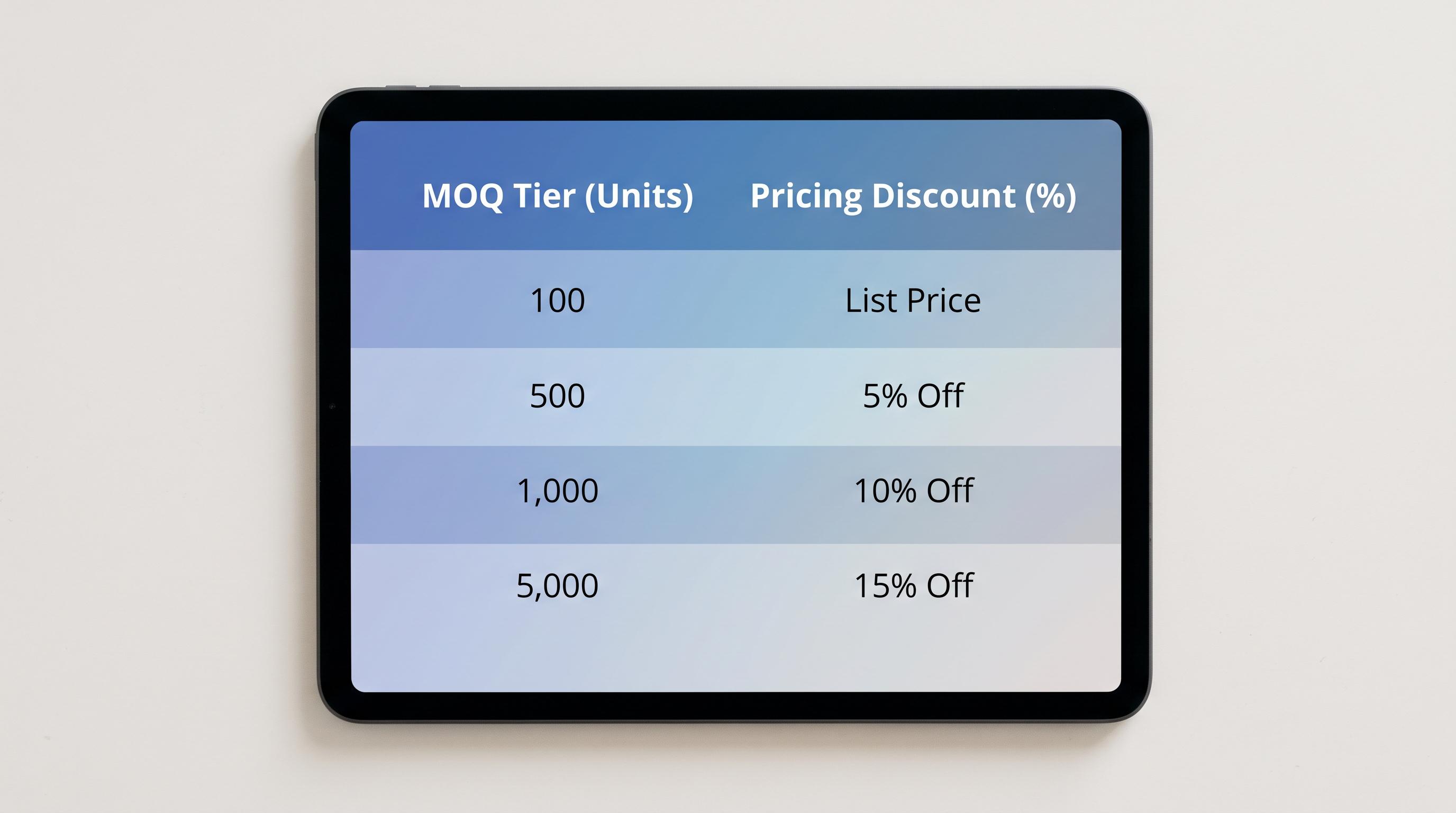
For a private label 1080p LED projector with a 0.33-inch DMD, our standard MOQ bands are 500 units for the first pilot run, 1,000 units for the first production run, and 3,000 units for the first replenishment run. For a 4K UHD laser phosphor unit with a 0.47-inch DMD, the bands move to 300, 800, and 2,000 because the optical engine BOM is more expensive to carry on the shelf. Hitting the first rung open up the second tier of FOB pricing, and hitting the second rung open up the third, with the pricing steps written into the master agreement rather than negotiated order by order.
| Tier | 1080p LED MOQ | 4K UHD Laser MOQ | FOB Shenzhen Price Step |
|---|---|---|---|
| Pilot | 500 | 300 | Base |
| First production | 1,000 | 800 | -6% vs. base |
| Replenishment | 3,000 | 2,000 | -12% vs. base |
A B2B procurement team auditing our line can pull the MOQ ladder, the lead time ladder, and the price ladder from the same b2b projector launch plan binder, which shortens their internal sign-off cycle by roughly two weeks. For B2C readers landing on this page through a retailer or marketplace listing, the same ladders explain why the unit sitting in the cart costs what it costs, and why the next promotion window is tied to a replenishment order rather than a spontaneous discount.
Payment Terms, Tooling Amortization, and IP Protection
Three contract items show up on every the SKU we sign in Shenzhen, and we recommend B2B buyers treat them as non-negotiable. First, payment terms: a 30% TT deposit at PO, a 60% balance against a pre-shipment inspection report that the buyer's QC team approves, and a 10% retention held for 60 days after B/L date. Second, tooling amortization: housing tooling for a private label projector typically runs $18,000-$32,000, and we offer a single-purchase option or a per-unit amortization over the first 5,000 units at the buyer's choice. Third, IP protection: the mold files, the firmware source, and the industrial design files are escrowed with a third party named in the master agreement, and ownership transfers to the buyer on the final tooling payment.
Those three items, plus the optical and firmware gates from the previous section, are what turn a b2b projector launch plan from a slide deck into a working program. For OEM buyers evaluating DataMax against another factory, we encourage them to score each candidate on the same ten-point checklist, because a plan that looks identical on a quote sheet often looks very different once the gates, the MOQ ladder, and the IP escrow terms are written down.
How to Choose the Right Factory for Your the model
A solid b2b projector launch plan only works if the factory behind it can actually execute. We have watched procurement teams at hotel chains, K-12 districts, and AV integrators score vendors on the same ten-point checklist for three years, and the teams that close in 30-45 days always score the same way. They verify the OEM/ODM scope in writing, confirm the MOQ ladder, lock the sample policy, pressure-test the lead time, and identify the contact channel before the second call.
Here is the shortlist we hand to every OEM buyer who asks how to choose a projector manufacturing partner for a new unit:
- MOQ ladder in writing — three rungs, priced, signed into the master agreement.
- Sample policy — paid engineering samples at $180-$450 each, refunded against the first PO, with a 12-18 day sample lead time.
- Lead time ladder — 35 days for an FHD LED pilot, 55 days for a 4K laser phosphor pilot, plus a fixed 7-day pre-shipment inspection buffer.
- Contact channel — a named program manager with a direct email and a 4-business-hour SLA on RFQ replies, not a generic sales inbox.
If those four boxes are checked, the rest of your b2b projector launch plan is execution. If they are not, every downstream gate slips.
Next Steps for Your this projector in 2026
For B2B procurement teams ready to move, the next step in any b2b projector launch plan for 2026 is a 30-minute scoping call followed by a written RFQ summary within 48 hours. Our program team responds to inbound RFQs in four business hours and ships engineering samples within 18 calendar days of a signed NDA. A typical pilot run closes in 35 days, and a first production run closes in 55 days from deposit clearance. Buyers evaluating us against a second factory should request our ten-point checklist, our MOQ ladder PDF, and our optical engine roadmap so the comparison happens on the same page. Reach us through the DataMax OEM contact form to start the projector conversation today, or review our private label projector guide for the full program flow. For teams sourcing a 4K laser hospitality unit, the GP95 hotel projector spec sheet is a useful reference point.
Quick Reference Checklist
Closing CTA
A b2b projector launch plan is the difference between a program that ships on calendar and one that slips into the next quarter. Send us your target spec, your target MOQ, and your target ship date, and our program team will return a written RFQ summary within 48 hours. Start the conversation through our DataMax OEM contact page, or pull the latest reference design from our home theater projector lineup to anchor the conversation in a real SKU.
