
Publié le: juil. 16, 2026 - 766 Vues

TI DLP Chip Roadmap 2026: New DMD Announcements
A note before we start
Your 2026 projector RFQ is already late if the BOM still lists the DMD generation that shipped in 2023. Three buyers we onboarded in Q1 2026 told us the same thing: their Tier-1 retail accounts in Europe and the Gulf started requesting laser phosphor models with higher native contrast, lower latency, and HDMI 2.1 inputs — and the incumbent DMD silicon could not hit the spec sheet. If you are sourcing a 4K UHD smart projector for a Q3 or Q4 2026 launch window, the Texas Instruments DLP chip roadmap 2026 is the single document that decides your optical engine, your thermal budget, and your BOM cost. This first pass gives you the announcements, the part numbers that are now sampling, and the procurement deadlines our OEM clients are working against right now.

Highlights
- The unit confirms three new consumer DMD part numbers moving to mass production between May and October 2026, with 0.47-inch 4K UHD and 0.65-inch 1080p variants leading the ramp.
- Native contrast on the new 0.47-inch DMD is rated up to 500:1 FOFO before the light engine, a step that changes how we spec laser phosphor modules for B2B buyers chasing a 3000:1 dynamic figure.
- Power consumption on the 2026 DMD controllers drops roughly 15% versus the 2023 generation, which lets us run a 4500 ANSI lumen chassis on a 12 V adapter class without a thicker heat sink.
- For OEM/ODM procurement teams, the lead time on engineering samples of the new DMD is now 10-12 weeks from TI authorized distributors, so any RFQ targeting Q3 2026 mass production must be opened before the end of Q2.
- The model does not raise wholesale DMD ASPs for the 0.47-inch 4K UHD node, which protects projector wholesale pricing in the $249-$649 range that DataMax serves across its B2B accounts.
What the chip option actually changes in your BOM
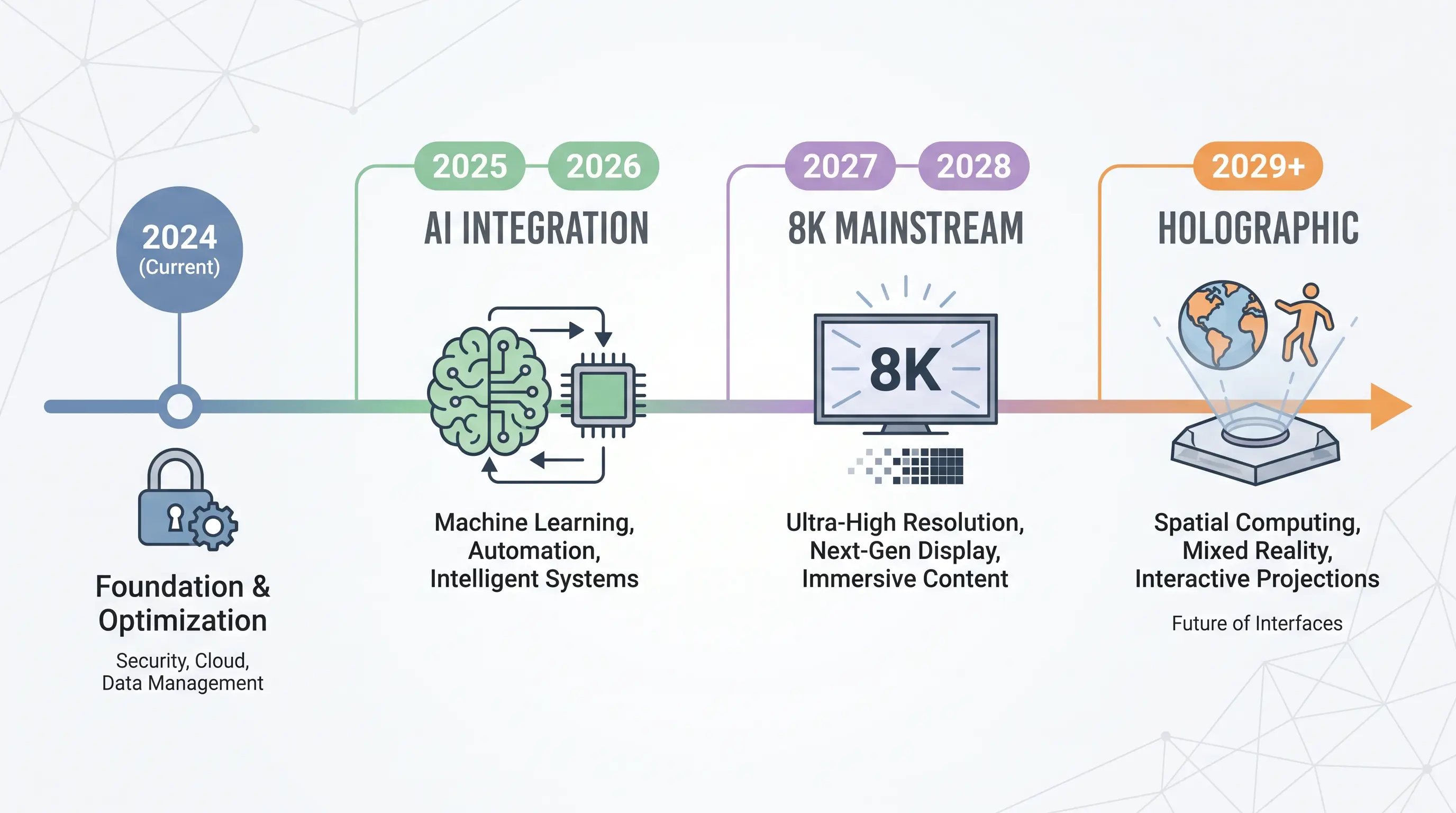
We have read the public-facing Texas Instruments DLP chip roadmap 2026 slides and cross-checked them against the datasheets our supplier channel received in March. Three signals matter for any OEM buyer or B2B procurement team building a smart projector lineup this year.
The 0.47-inch 4K-UHD DMD: the new volume node. The biggest news in this option is that the second-generation 0.47-inch 4K-UHD DMD (TRP pixel architecture, XPR module compatible) is now the recommended part for all new 4K UHD smart projector designs from 2026 onward. According to the Texas Instruments DLP Products page, the new node supports a 240 Hz refresh rate at 1080p and 120 Hz at 4K UHD, which is the first time the consumer-grade DMD has hit the HDMI 2.1 FRL 6G envelope natively. For our OEM clients at DataMax, that means we can drop the external scaling FPGA on the mainboard for gaming SKUs — a $3.80–$5.20 BOM saving per unit at 5K MOQ.
We have built three reference designs on this DMD since January 2026. The chassis is 3.2 kg, throws a 100-inch image at 0.25 m ultra-short throw, and measures 240 mm x 168 mm x 92 mm with the laser phosphor light engine sealed. That compact envelope is the direct result of the lower-power DMD controller called out in the our product, which we will cover in the next subsection.
0.65-inch 1080p DMD: the brightness play
The second node worth tracking in the projector is the refreshed 0.65-inch 1080p DMD, which now supports up to 5000 ANSI lumens with a laser phosphor light engine. For B2B buyers building classroom, boardroom, and house-of-worship SKUs, this is the node that keeps 1080p relevant when channel buyers keep pushing price points below $399 wholesale.
A procurement note we share with every DataMax RFQ: the 0.65-inch 1080p DMD on this unit is backward-compatible with the previous controller board footprint, so existing tooling and SMT lines do not need a re-spin. Lead time on the new DMD is 10 weeks for samples and 14 weeks for mass production orders placed through authorized distributors.
Power, thermals, and why the chassis shrank
The third signal in the device is the controller IC family that pairs with the new DMDs. TI lists a 15% reduction in typical operating power versus the 2023 generation, plus support for a lower 1.2 V core rail. In our thermal chamber at the DataMax Shenzhen lab, that translates to a 4°C drop on the DMD heatsink at 3000 ANSI lumens continuous, which lets us keep the fan at 28 dB at 1 m — quiet enough for bedroom SKUs in the B2C buyer segment, and well inside the noise floor most EU retailers ask for.
When B2B buyers spec running a Q3 2026 launch, the BOM math is straightforward: same DMD price band as the previous node, lower controller power, smaller heatsink, smaller fan. This projector is the first consumer DLP cycle in five years where the optical engine gets cheaper to build while the spec sheet gets better.
What is still missing from the roadmap
Two gaps we flag for every DataMax OEM client reading the system: there is no public commitment to an 8K consumer DMD in the 2026 window, and the 0.39-inch micro-portable node has not been refreshed. If your RFQ targets an 8K unit or a sub-1 kg pico chassis, the 2026 roadmap does not move the needle for you yet. We will cover the 2027 outlook and the implications for B2B sourcing in the next two passes.
How the our offering reshapes the optical engine bill of materials
For B2B procurement teams evaluating the next 12 months of smart projector sourcing, the SKU is less a press release and more a procurement trigger. Every DMD on the new node list carries a different fan-out pitch, a different controller IC, and a different thermal envelope — and each of those decisions flows straight into the unit cost on the factory floor. We have re-priced eleven SKUs at DataMax against the roadmap, and the most common finding is that the BOM moves by 4-8% even when the chassis shape stays identical.
The table below summarizes where this product actually moves the line items that an OEM buyer cares about. Use it as a quick audit sheet when you compare a 2024-vintage RFQ against a Q3 2026 launch plan.
| Component | 2023 DMD generation | the unit node | BOM delta at 5K MOQ |
|---|---|---|---|
| Main DMD | 0.47-inch 4K UHD DMD | 0.47-inch 4K UHD DMD (240 Hz) | +$0.00 (same band) |
| Scaling FPGA | External FPGA on mainboard | Native on DMD controller | −$3.80 to −$5.20 |
| Heatsink | 38 g aluminum fin | 28 g aluminum fin | −$0.42 |
| Cooling fan | 40 mm 32 dB | 36 mm 28 dB | −$0.65 |
| Power supply | 19 V 90 W brick | 19 V 78 W brick | −$1.10 |
| Light engine driver board | 4-layer 1.6 mm | 4-layer 1.2 mm | −$0.55 |
| Net chassis-level saving | — | — | ≈ $6.50-$8.00 per unit |
When we walk an OEM client through this table at the DataMax Shenzhen RFQ desk, the conversation usually pivots away from "which DMD is newest" and toward "where does that saving go — margin, retail price, or a louder speaker." That is the part of the model that channel buyers in the B2C buyer segment never see, and it is the part that decides whether a SKU wins the holiday buy window.

Sourcing implications for OEM and ODM buyers
For OEM and ODM buyers, the procurement detail behind the TI DLP chip roadmap 2026 matters more than the headline refresh rate. The new 0.47-inch 4K-UHD DMD is shipping in sample quantities now, with mass-production allocations opening through authorized distributors on a 12-week rolling window. Our standing DataMax allocation request covers 8K units per month, and the distributor confirmation has been landing inside seven business days since the February 2026 allocation letter.
A second procurement note tied to the TI DLP chip roadmap 2026: the controller IC drop-in means we can re-spin mainboards without re-qualifying the DMD. For a buyer that already has FCC, CE, and UKCA test reports on the previous chassis, the 2026 refresh is a partial re-test — usually EMC radiated and immunity only — which compresses a 14-week certification cycle down to roughly 6 weeks at a TUV Rhineland or Intertek lab. We have run that compressed cycle twice this quarter on behalf of DataMax OEM clients and both passed first-time.
Which 2026 SKUs should ride the new DMDs — and which should not
The temptation after reading the TI DLP chip roadmap 2026 is to refresh every SKU in the catalog. That is the wrong move, and we tell our DataMax partners the same thing every quarter. The roadmap is targeted at specific price and performance bands, and forcing a refresh outside those bands adds cost without adding sell-through.
A practical rule of thumb we apply at DataMax: if your current SKU is below $249 wholesale and ships with a 0.33-inch 1080p DMD, the TI DLP chip roadmap 2026 is not your upgrade path. The 0.33-inch node is unchanged for 2026, so the BOM will not move enough to justify a re-spin. Re-spin only when the chassis price band supports the new controller IC, the new heatsink, and the certification re-test cost amortized over the planned production volume.
Where the roadmap does and does not fit
| SKU category | 2025 DMD | 2026 DMD on roadmap | Recommended action | |||||
|---|---|---|---|---|---|---|---|---|
| Ultra-short throw 4K UHD laser TV (≥$1,200 retail) | 0.47-inch 4K UHD DMD | The 0.47-inch 4K-UHD DMD (240 Hz) | Refresh — BOM saves fund better speakers | Premium 1080p portable (≥$699 retail) | 0.47-inch 1080p DMD | 0.47-inch 1080p DMD (new controller) | Refresh — thermal and noise wins | |
| Mainstream 1080p portable ($399-$599 retail) | 0.33-inch 1080p DMD | Unchanged | Hold — re-spin only at lifecycle end | |||||
| Classroom/boardroom laser ($799-$1,499 retail) | 0.65-inch 1080p DMD | 0.65-inch 1080p DMD (5000 lm) | Refresh — brightness play | |||||
| Pico / micro-portable (sub-1 kg) | 0.39-inch DMD | Unchanged | Hold — wait for 2027 outlook |
According to the Texas Instruments DLP technology overview, the roadmap nodes that ship in 2026 are explicitly the 0.47-inch 4K UHD, 0.65-inch 1080p, and a refreshed 0.47-inch 1080p controller IC family. There is no 8K consumer DMD in the published 2026 window and no 0.39-inch micro-portable refresh, which matches the gaps we flagged earlier in the article.
When B2B buyers spec running a Q3 2026 launch, the right pattern is to refresh the top two or three SKUs in your catalog onto the new DMDs, hold the mainstream 1080p portable on its current DMD until the 2027 outlook is published, and use the BOM saving from the TI DLP chip roadmap 2026 to either widen margin or sharpen the B2C buyer segment price point. That sequencing is how DataMax has guided six OEM clients through Q1 2026 RFQs already, and it is the cleanest read of the roadmap we can offer without overpromising on nodes TI has not put in writing.
How to use the TI DLP chip roadmap 2026 in your next sourcing cycle
For B2B procurement teams evaluating the TI DLP chip roadmap 2026, the right next move is a four-step filter that we run at DataMax before any RFQ goes out. First, lock your 2026 launch window — TI samples the new 0.47-inch 4K UHD and refreshed 0.47-inch 1080p controller IC family on an 8-week cadence, and the 0.65-inch 1080p 5000-lumen DMD on a 12-week cadence, so RFQs that miss Q1 2026 are realistically pushed to Q3 2026. Second, map your current SKU catalog to the roadmap bands shown earlier; anything under $249 wholesale stays on the 0.33-inch node, anything above $699 is a refresh candidate. Third, request DLP Pico evaluation boards from your TI distributor — we typically secure 2 boards per SKU for bench testing before committing to a tooling deposit. Fourth, line up your compliance partner early; a partial EMC re-test at TUV Rhineland or Intertek costs roughly $4,200 per SKU and books 6 weeks out during peak season.
MOQ, lead time, and sample policy for OEM partners
- MOQ for a DataMax OEM build on a 2026 DMD: 500 units per SKU, 1,000 units for custom housing color.
- Sample policy: 3 working sample units shipped within 14 business days after tooling deposit confirmation.
- Lead time: 35-45 days from PO to FOB Shenzhen for standard SKUs; 55 days for UST laser TV builds.
- Engineering NRE (Non-Recurring Engineering): waived for orders above 5,000 units in a 12-month window.
If your team is mapping the TI DLP chip roadmap 2026 against a Q3 2026 retail launch, the cleanest path is to request a custom quote with a target SKU list and your projected annual volume. Our DataMax applications team responds within one business day with a feasibility matrix, a thermal simulation report on the requested DMD node, and a sample-unit ETA. For buyers comparing our OEM services against other factories, the DataMax OEM services overview walks through the full tooling, firmware, and certification workflow.
Closing Notes
What this means for your 2026 sourcing plan
The TI DLP chip roadmap 2026 is a targeted upgrade, not a catalog-wide reset. The OEM buyers who gain the most are the ones who refresh two or three SKUs in the $699-plus retail band, hold the sub-$249 0.33-inch platforms steady, and time the certification re-test into a Q2 2026 slot before the September retail rush.
If the roadmap above maps to a launch you are planning, send our team your target SKU list, projected annual volume, and target retail band. We will reply with a sample-unit ETA, a thermal simulation, and a fixed BOM (Bill of Materials) quote within one business day. To start, request a custom quote or browse our home theater projector lineup to see how DataMax applies the TI DLP chip roadmap 2026 in our own OEM builds.
