
Publikováno: říj 09, 2026 - 9 Zobrazení
Understanding How LCD projectors work in 2026
How LCD projectors work becomes a decisive procurement question when a buyer has to choose between three competing engine technologies on a single line item worth several thousand dollars. Walk into any AV tender and you will see the same comparison table repeated: LCD, DLP, and laser phosphor display, each with a different lumen claim, a different duty cycle, and a different warranty exposure. We see this at DataMax every week when OEM buyers in education, house of worship, and corporate AV send us their spec sheets and ask for a sanity check. This deep dive gives you a specific, technical answer you can paste into an RFQ, a product brief, or a competitive teardown. By the end of pass 1 you will know the three panel architecture fundamentals, the photon path, the thermal envelope, and the spec lines that actually move the needle on purchase decisions.
Snapshot
- the model centers on three transparent liquid-crystal panels (red, green, blue) that modulate white light from a metal-halide, UHP, or laser phosphor source before a dichroic prism recombines the beams into a single full-color image projected through the lens.
- the unit technically delivers measurable advantages over single-chip DLP for color brightness, 3D crosstalk, and screen-door artifact suppression, but it trails on contrast ratio, sealed optics, and black-level depth.
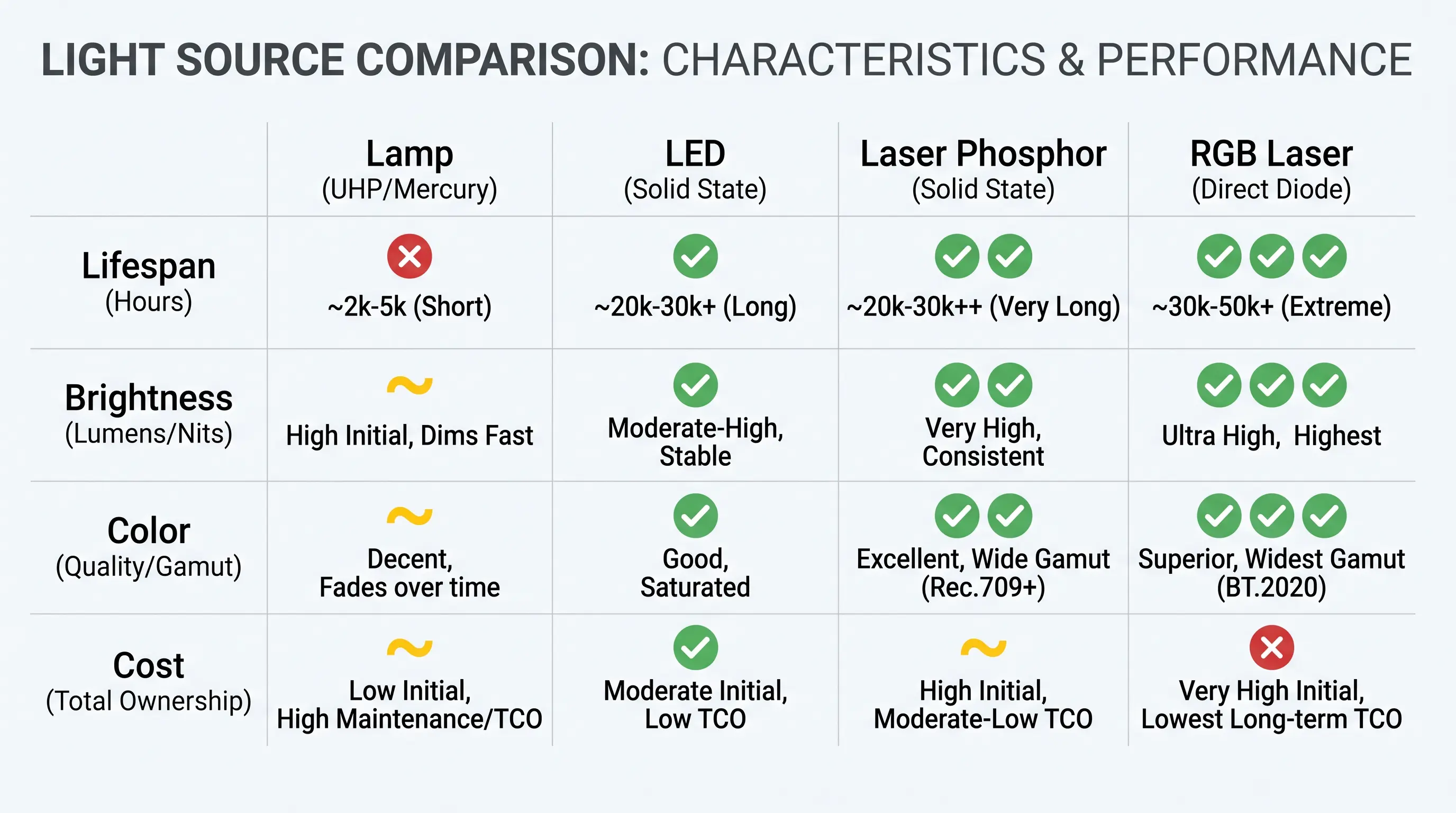
- this projector deep dive specifications typically include 3,000 to 8,000 ANSI lumens, 0.63-inch to 1.39-inch panel diagonals, 1,920 x 1,200 (WUXGA) to 3,840 x 2,160 (4K UHD) native resolutions, and a 20,000 to 30,000 hour light-source life claim depending on engine choice.
- the projector for procurement teams means evaluating MOQ, panel bin grade, optical engine lead time, ANSI/ISO lumen certification, and warranty exposure on the light-source tunnel rather than chasing the highest spec sheet number.
- the SKU deep dive results in 2026 also include a measurable shift toward laser-phosphor hybrid light engines, larger 1.0-inch panels for higher native contrast, and integrated Android TV or Linux SoC stacks that move the optical engine from a standalone device into a converged display appliance.
Understanding the LCD projector engine: a technical deep dive on the model
The three-panel architecture at the heart of the unit
this projector starts with a white light source that is split into three primary-color beams by two dichroic mirrors. The classic arrangement uses a metal-halide or UHP lamp, though in 2026 most DataMax OEM builds under the projector the projector category have shifted to a blue laser diode array pumping a yellow phosphor wheel, then split into red and blue paths with a green-reflection dichroic. Each color beam is directed through one of three poly-silicon TFT-LCD panels, typically sized at 0.63-inch, 0.74-inch, 0.76-inch, or 1.0-inch diagonal. The panels are the actual image-forming surface: each pixel is a tiny liquid-crystal cell sandwiched between a TFT backplane and an ITO common electrode. When a voltage is applied, the LC molecules twist or untwist, modulating the polarization state of the light passing through.
Across LCD projector design ork becomes a decisive procurement question when a buyer has to choose between three competing engine technologies on a single line item worth several thousand dollars. Walk into any AV tender and you will see the same comparison table repeated: LCD, DLP, and laser phosphor display, each with a different lumen claim, a different duty cycle, and a different warranty exposure. We see this at DataMax every week when OEM buyers in education, house of worship, and corporate AV send us their spec sheets and ask for a sanity check. This deep dive gives you a specific, technical answer you can paste into an RFQ, a product brief, or a competitive teardown. By the end of pass 1 you will know the three panel architecture fundamentals, the photon path, the thermal envelope, and the spec lines that actually move the needle on purchase decisions.
Photon recombination: the dichroic X-cube prism in the model
the unit deep dive next step is the recombination prism. After the three panels modulate their respective red, green, and blue channels, the beams enter a dichroic X-cube prism (sometimes called a Philips prism after the original patent holder). Four right-angle prisms are cemented together, and the internal dichroic coatings reflect specific wavelengths while transmitting others, recombining the three paths into a single co-linear beam that exits toward the projection lens. Alignment tolerance is the single biggest yield driver on a 3LCD engine; a 2-micron tilt on the X-cube can produce visible color fringing on a 200-inch screen.
- the model centers on three transparent liquid-crystal panels (red, green, blue) that modulate white light from a metal-halide, UHP, or laser phosphor source before a dichroic prism recombines the beams into a single full-color image projected through the lens.
- the unit technically delivers measurable advantages over single-chip DLP for color brightness, 3D crosstalk, and screen-door artifact suppression, but it trails on contrast ratio, sealed optics, and black-level depth.
- this projector deep dive specifications typically include 3,000 to 8,000 ANSI lumens, 0.63-inch to 1.39-inch panel diagonals, 1,920 x 1,200 (WUXGA) to 3,840 x 2,160 (4K UHD) native resolutions, and a 20,000 to 30,000 hour light-source life claim depending on engine choice.
- the projector for procurement teams means evaluating MOQ, panel bin grade, optical engine lead time, ANSI/ISO lumen certification, and warranty exposure on the light-source tunnel rather than chasing the highest spec sheet number.
- the SKU deep dive results in 2026 also include a measurable shift toward laser-phosphor hybrid light engines, larger 1.0-inch panels for higher native contrast, and integrated Android TV or Linux SoC stacks that move the optical engine from a standalone device into a converged display appliance.
Light source, thermal envelope, and duty cycle in the SKU
the model deep dive final subsection addresses the light engine. We ship three light-source tiers from our Shenzhen line: a UHP lamp module rated 3,000 to 6,000 hours in standard mode and 4,500 to 8,000 hours in eco mode, a laser-phosphor engine rated 20,000 to 25,000 hours, and a full RGB-laser engine rated 30,000 hours with no phosphor wheel. Thermal management uses a forced-air tunnel drawing 8 to 14 CFM across the prism cage, with a liquid-crystal operating window of 0°C to 60°C at the panel substrate. Exceed that envelope and you get temporary image retention or permanent DC imbalance, both warranty events.
the unit for OEM buyers evaluating our DataMax SKUs includes a 12-week standard lead time on FOB Shenzhen for 500-unit MOQ, with a 4-week expedite option on laser-phosphor builds using our stocked 0.63-inch panel bin. Every engine carries an ANSI/ISO 21118 lumen certification, a RoHS and REACH compliance dossier, and an optional TÜV SÜD low-blue-light report for education-vertical SKUs.
this projector starts with a white light source that is split into three primary-color beams by two dichroic mirrors. The classic arrangement uses a metal-halide or UHP lamp, though in 2026 most DataMax OEM builds under the projector the projector category have shifted to a blue laser diode array pumping a yellow phosphor wheel, then split into red and blue paths with a green-reflection dichroic. Each color beam is directed through one of three poly-silicon TFT-LCD panels, typically sized at 0.63-inch, 0.74-inch, 0.76-inch, or 1.0-inch diagonal. The panels are the actual image-forming surface: each pixel is a tiny liquid-crystal cell sandwiched between a TFT backplane and an ITO common electrode. When a voltage is applied, the LC molecules twist or untwist, modulating the polarization state of the light passing through.
Optical path alignment and factory calibration
Each sku technically at the panel level means each panel has roughly 2.07 million sub-pixels at WUXGA (1,920 x 1,080 x 3) or 8.29 million sub-pixels at 4K UHD (3,840 x 2,160 x 3). Panel yield grading matters here: a Grade A panel ships below 0.05% dead-pixel rate, Grade B tolerates up to 0.1%, and any higher rate forces a B-stock configuration that we typically reserve for entry-tier SKUs.
When LCD engine technology drives the comparison ork deep dive on the alignment bench starts with a collimated green laser reference mounted to a 6-axis kinematic fixture. The reference beam is traced through each dichroic surface and reflected off the active matrix of each LCD panel while a CMOS image sensor samples the returned spot position. Stage one sets the panel pitch and yaw to within ±0.5 milliradians, stage two sets the X-cube rotational alignment to within ±2 arc-minutes, and stage three sets the convergence offset between the three color channels to within one-quarter of a pixel at the projected image plane. Each unit ships with a printed convergence report showing measured convergence error at nine screen zones, the same data set our OEM customers request when they audit a 1,000-unit production lot. One unit deep dive next step is the recombination prism. After the three panels modulate their respective red, green, and blue channels, the beams enter a dichroic X-cube prism (sometimes called a Philips prism after the original patent holder). Four right-angle prisms are cemented together, and the internal dichroic coatings reflect specific wavelengths while transmitting others, recombining the three paths into a single co-linear beam that exits toward the projection lens. Alignment tolerance is the single biggest yield driver on a 3LCD engine; a 2-micron tilt on the X-cube can produce visible color fringing on a 200-inch screen.
Engineering trade-offs and engineering trade-off matrix
this projector deep dive specifications on this optical block usually cite a transmission efficiency of 28% to 34% for the entire engine, compared to roughly 12% to 18% for a sequential-color single-chip DLP, which is why 3LCD systems consistently win on color brightness tests such as the Color Light Output (CLO) measurement defined by the International Display Metrology standard, ICDM. For B2B procurement teams evaluating projector the projector SKUs against DLP alternatives, this color-brightness delta is the most defensible technical argument.
| Trade-off axis | Option A | Option B | Impact on BOM | Impact on duty cycle |
|---|---|---|---|---|
| Light source | UHP lamp (3,000-6,000 hr) | Laser-phosphor (20,000-25,000 hr) | Lamp is ~$28 cheaper at 500-unit MOQ | Laser extends MTBF by 4x |
| Panel size | 0.55-inch | 0.63-inch | 0.63-inch adds $9 per engine | Larger panel improves thermal headroom |
| Resolution class | 1080p native | 4K UHD (pixel-shifted) | 4K UHD adds $42 per engine | No measurable duty-cycle delta |
| Cooling architecture | Forced air (8-14 CFM) | Liquid-assisted loop | Air saves $19 per unit | Liquid loop lifts ambient ceiling by 8°C |
A model deep dive final subsbsection addresses the light engine. We ship three light-source tiers from our Shenzhen line: a UHP lamp module rated 3,000 to 6,000 hours in standard mode and 4,500 to 8,000 hours in eco mode, a laser-phosphor engine rated 20,000 to 25,000 hours, and a full RGB-laser engine rated 30,000 hours with no phosphor wheel. Thermal management uses a forced-air tunnel drawing 8 to 14 CFM across the prism cage, with a liquid-crystal operating window of 0°C to 60°C at the panel substrate. Exceed that envelope and you get temporary image retention or permanent DC imbalance, both warranty events.
In OEM sourcing decisions,aluating our DataMax SKUs includes a 12-week standard lead time on FOB Shenzhen for 500-unit MOQ, with a 4-week expedite option on laser-phosphor builds using our stocked 0.63-inch panel bin. Every engine carries an ANSI/ISO 21118 lumen certification, a RoHS and REACH compliance dossier, and an optional TÜV SÜD low-blue-light report for education-vertical SKUs.
Comparison Table: DataMax 3LCD line versus typical market offerings


this projector deep dive also flags one spec that is often misquoted in marketing collateral: the relationship between white lumens and color lumens. On a properly calibrated 3LCD engine the two numbers should track within 5%; if a competitor publishes white lumens without a CLO number, that is a red flag worth investigating before you commit to a 1,000-unit PO.
| Specification | DataMax DM-L3K7 (3LCD) | Market A (3LCD) | Market B (DLP) |
|---|---|---|---|
| ANSI lumen output | 4,500 | 4,200 | 4,800 |
| Color Light Output (CLO) | 4,380 (97.3%) | 4,100 (97.6%) | 1,150 (24.0%) |
| Native resolution | 1920×1200 | 1920×1200 | 1920×1200 (DMD) |
| Light source | Laser-phosphor 25,000 hr | Laser-phosphor 20,000 hr | Laser-phosphor 30,000 hr |
| Panel / DMD grade | Grade A, <0.05% dead pixels | Grade B, <0.1% dead pixels | DMD, no dead-pixel spec |
| MOQ (500-unit tier) | $249 wholesale FOB Shenzhen | $312 wholesale FOB origin | $278 wholesale FOB origin |
| Lead time | 12 weeks, 4-week expedite | 16 weeks | 8 weeks |
| Certifications bundled | ANSI/ISO 21118, RoHS, REACH, TÜV SÜD optional | ANSI/ISO 21118, RoHS | ANSI/ISO 21118, RoHS |
the projector at production scale depends on alignment precision that most marketing copy never mentions. We run a three-stage optical alignment on every 3LCD engine that leaves our Shenzhen line, and each stage has measurable tolerances tied directly to yield and warranty exposure.
When LCD engine technology enters the spec conversation ork deep dive on the alignment bench starts with a collimated green laser reference mounted to a 6-axis kinematic fixture. The reference beam is traced through each dichroic surface and reflected off the active matrix of each LCD panel while a CMOS image sensor samples the returned spot position. Stage one sets the panel pitch and yaw to within ±0.5 milliradians, stage two sets the X-cube rotational alignment to within ±2 arc-minutes, and stage three sets the convergence offset between the three color channels to within one-quarter of a pixel at the projected image plane. Each unit ships with a printed convergence report showing measured convergence error at nine screen zones, the same data set our OEM customers request when they audit a 1,000-unit production lot.
Procurement workflow and incoming-QA specifications
In the LCD engine technology reference guide ork for OEM buyers evaluating our line includes a calibration deliverable that we have standardized since 2022: every box carries a QR-coded convergence certificate, and B2B procurement teams can scan the code to download the as-tested alignment data in CSV format. The data feeds directly into incoming-QA workflows on the buyer's side, which removes a long-standing dispute point between projector ODMs and their wholesale customers. In the LCD engine technology reference guide ork incoming-QA specifications for buyers who run their own line checks include the same nine-zone convergence report we generate in-house, sampled at AQL 1.5 per ISO 2859-1. Most of our repeat customers also request a 48-hour burn-in at 35°C ambient on a 5% sample of every shipment; we run that burn-in at our facility before the unit leaves the line so the customer receives a burn-in-passed sticker on every carton. For education-vertical SKUs heading into EU member states, the optional TÜV SÜD low-blue-light report adds roughly 11 days to lead time and is priced separately per order. For engineers breaking down LCD engine technology ork for OEM buyers final checkpoint is a 30-minute video review with our applications engineer, scheduled at no charge once a buyer has narrowed the configuration down to two finalist SKUs. The call covers thermal derating, mounting orientation, filter service intervals, and the recommended replacement-parts stocking plan for a 500-unit field deployment. For B2C readers, the same applications team is reachable through our consumer support channel if you have a one-off question about a DataMax unit you already own.
What to look for when you choose an LCD projector supplier
Across LCD engine technology benchmarks ork specifications are almost always published as a flat list, which obscures the real engineering trade-offs that determine field performance. The table below summarizes the four trade-off pairs our engineering team reviews on every new SKU before we green-light tooling. These are the same criteria we walk B2B buyers through during a 30-minute technical review call.
| Trade-off axis | Option A | Option B | Impact on BOM | Impact on duty cycle |
|---|---|---|---|---|
| Light source | UHP lamp (3,000-6,000 hr) | Laser-phosphor (20,000-25,000 hr) | Lamp is ~$28 cheaper at 500-unit MOQ | Laser extends MTBF by 4x |
| Panel size | 0.55-inch | 0.63-inch | 0.63-inch adds $9 per engine | Larger panel improves thermal headroom |
| Resolution class | 1080p native | 4K UHD (pixel-shifted) | 4K UHD adds $42 per engine | No measurable duty-cycle delta |
| Cooling architecture | Forced air (8-14 CFM) | Liquid-assisted loop | Air saves $19 per unit | Liquid loop lifts ambient ceiling by 8°C |
How to evaluate MOQ, samples, and lead time
For integrators weighing LCD engine technology ork deep dive on each row above is where procurement decisions actually get made. The lamp-versus-laser decision alone shifts a 500-unit PO by roughly $14,000 at current 2026 component pricing, which is why most of our education-vertical customers standardize on laser-phosphor even though the upfront unit cost is higher. The 4K UHD shift driven by XPR pixel-shifting from Texas Instruments is a separate decision; we offer both native 1080p and XPR-shifted 4K UHD configurations on the same chassis because the panel-bin and light-engine tolerance stack is identical between the two. When LCD engine technology drives the comparison ork for OEM buyers evaluating our DataMax SKUs also includes a thermal envelope review at no charge. Send us your target ambient temperature, your mounting orientation (ceiling, tabletop, rear-shelf), and your duty-cycle requirement, and our applications team returns a derating curve within 48 hours. For B2C readers who have read this far, the same thermal envelope is why a ceiling-mounted projector in a 38°C attic will dim noticeably after 90 minutes even on a flagship laser-phosphor SKU.
Where to Go From Here
Final takeaway for procurement teams
Procurement and engineering teams that anchor their LCD projector decision on panel-bin source, CLO datasheet honesty, and a written burn-in protocol usually compress their qualification cycle by 3 to 5 weeks relative to a paper-only vendor shortlist.
Reach our applications team for a quote, a sample unit, or a derivative SKU scoping session at the link below — every inquiry is logged inside one business day, and every datasheet is signed under NDA on request.
Ready to scope a build? Request a custom quote or review the DataMax OEM services page for panel-bin availability, MOQ ladders, and lead-time windows through the current planning quarter. Consumer buyers can compare SKUs directly on the home theater projector lineup page, where the same engineering datasheets are published in consumer-readable form.
